


Page 194 - Physics_Form_2
P. 194
Physics for Secondary Schools


           combine to produce magenta, which       Addition of colours of light
           is the complement of green. Thus, two   Generation  of various  colours  of  light  by
           primary colours combine to produce the   mixing of the three primary colours of light is
           complement of the third primary colour,   known as colour addition. The colour addition
           whereas the three primary colours       principles can be used to make predictions of
           combine to produce white light. One     the colours that would result when different
          FOR ONLINE READING ONLY
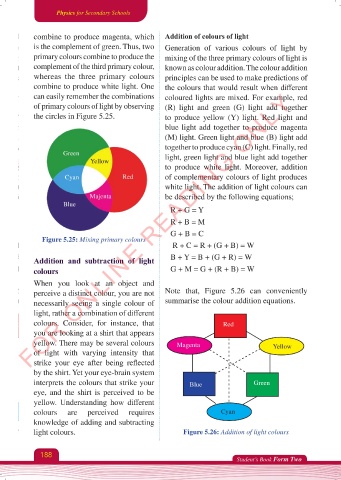
           can easily remember the combinations    coloured lights are mixed. For example, red
           of primary colours of light by observing   (R) light and green (G) light add together
           the circles in Figure 5.25.             to produce yellow (Y)  light. Red light and
                                                   blue light add together to produce magenta
                                                   (M) light. Green light and blue (B) light add
                                                   together to produce cyan (C) light. Finally, red
                    Green                          light, green light and blue light add together
                            Yellow
                                                   to produce  white  light.  Moreover, addition
                     Cyan             Red          of complementary colours of light produces
                                                   white light. The addition of light colours can
                            Majenta                be described by the following equations;
                    Blue
                                                     R + G = Y
                                                     R + B = M
                                                     G + B = C
              Figure 5.25: Mixing primary colours
                                                      R + C = R + (G + B) = W

           Addition  and  subtraction  of  light     B + Y = B + (G + R) = W
           colours                                   G + M = G + (R + B) = W
           When you look at an object  and
           perceive a distinct colour, you are not   Note that, Figure 5.26 can conveniently
           necessarily seeing a single colour of   summarise the colour addition equations.
           light, rather a combination of different
           colours.  Consider, for instance,  that                  Red
           you are looking at a shirt that appears
           yellow. There may be several colours        Magenta                      Yellow
           of light  with varying  intensity  that
           strike  your  eye  after  being  reflected
           by the shirt. Yet your eye-brain system
           interprets the colours that strike your        Blue                Green
           eye,  and the  shirt is perceived  to be
           yellow.  Understanding  how  different
           colours   are   perceived    requires                    Cyan
           knowledge of adding and subtracting
           light colours.                               Figure 5.26: Addition of light colours


             188
                                                                         Student’s Book Form Two


     Physics Form 2 Final.indd   188                                                        25/10/2025   10:28

