


Page 190 - Physics_Form_2
P. 190
Physics for Secondary Schools


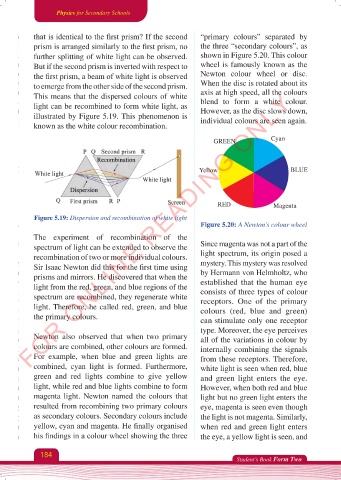
           that is identical to the first prism? If the second   “primary  colours” separated  by
           prism is arranged similarly to the first prism, no   the three “secondary colours”, as
           further splitting of white light can be observed.   shown in Figure 5.20. This colour
           But if the second prism is inverted with respect to   wheel is famously known as the
           the first prism, a beam of white light is observed   Newton colour  wheel  or disc.
           to emerge from the other side of the second prism.   When the disc is rotated about its
          FOR ONLINE READING ONLY
           This means that the dispersed colours of white     axis at high speed, all the colours
           light can be recombined to form white light, as    blend to form a white colour.
                                                              However, as the disc slows down,
           illustrated by Figure 5.19. This phenomenon is     individual colours are seen again.
           known as the white colour recombination.

                                                                  GREEN            Cyan


                                                             Yellow                      BLUE


                                                                   RED              Magenta
           Figure 5.19: Dispersion and recombination of white light
                                                              Figure 5.20: A Newton’s colour wheel
           The  experiment  of recombination  of the
           spectrum of light can be extended to observe the   Since magenta was not a part of the
           recombination of two or more individual colours.   light spectrum, its origin posed a
           Sir Isaac Newton did this for the first time using   mystery. This mystery was resolved
           prisms and mirrors. He discovered that when the    by Hermann von Helmholtz, who
           light from the red, green, and blue regions of the   established that the human eye
                                                              consists of three types of colour
           spectrum are recombined, they regenerate white     receptors. One of the primary
           light. Therefore, he called red, green, and blue   colours (red, blue and green)
           the primary colours.                               can stimulate only one receptor
                                                              type. Moreover, the eye perceives
           Newton also observed that  when two primary        all of the variations in colour by
           colours are combined, other colours are formed.    internally combining the signals
           For example, when blue and green lights are        from these receptors. Therefore,
           combined,  cyan  light  is  formed.  Furthermore,   white light is seen when red, blue
           green and red lights combine  to give yellow       and green light enters the eye.
           light, while red and blue lights combine to form   However, when both red and blue
           magenta light. Newton  named the  colours  that    light but no green light enters the
           resulted from recombining two primary colours      eye, magenta is seen even though
           as secondary colours. Secondary colours include    the light is not magenta. Similarly,
           yellow, cyan and magenta. He finally organised     when red and green light enters
           his findings in a colour wheel showing the three   the eye, a yellow light is seen, and


             184
                                                                         Student’s Book Form Two


     Physics Form 2 Final.indd   184                                                        25/10/2025   10:28

