


Page 185 - Physics_Form_2
P. 185
Refraction and dispersion of light

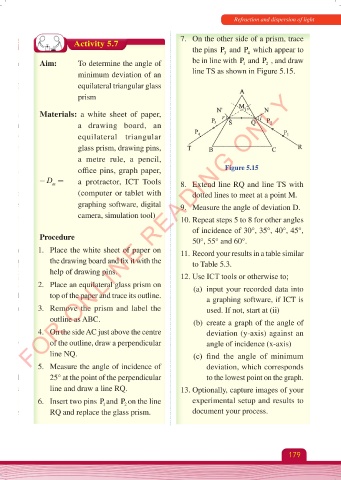
                                                        7.  On the other side of a prism, trace
                       Activity 5.7
                                                           the pins P  and P  which appear to
                                                                     3
                                                                            4
             Aim:        To determine the angle of         be in line with P  and P  , and draw
                                                                                 2
                                                                          1
                         minimum deviation of an           line TS as shown in Figure 5.15.
                         equilateral triangular glass
          FOR ONLINE READING ONLY
                         prism

             Materials: a white sheet of paper,

                         a drawing board, an
                         equilateral triangular
                         glass prism, drawing pins,
                         a metre rule, a pencil,
                         office pins, graph paper,                   Figure 5.15
 i−r +e−r +180°− D = 180° a protractor, ICT  Tools      8.  Extend line RQ and line TS with
                 m
                         (computer or tablet with          dotted lines to meet at a point M.

                         graphing software, digital     9.  Measure the angle of deviation D.
                         camera, simulation tool)
                                                        10. Repeat steps 5 to 8 for other angles
                                                           of incidence of 30°, 35°, 40°, 45°,
             Procedure                                     50°, 55° and 60°.
             1.  Place the white sheet of paper on      11. Record your results in a table similar
                the drawing board and fix it with the      to Table 5.3.
                help of drawing pins.                   12. Use ICT tools or otherwise to;

             2.  Place an equilateral glass prism on       (a)  input your recorded data into
                top of the paper and trace its outline.        a graphing software, if ICT is
             3.  Remove the prism and label the                used. If not, start at (ii)
                outline as ABC.                            (b)  create a graph of the angle of

             4.  On the side AC just above the centre          deviation (y-axis) against an
                of the outline, draw a perpendicular           angle of incidence (x-axis)
                line NQ.                                   (c)  find  the  angle  of  minimum
             5.  Measure the angle of incidence of             deviation, which corresponds
                25° at the point of the perpendicular          to the lowest point on the graph.
                line and draw a line RQ.                13. Optionally, capture images of your

             6.  Insert two pins P and P on the line       experimental setup and results to
                                1
                                       2
                RQ and replace the glass prism.            document your process.


                                                                                        179


     Physics Form 2 Final.indd   179                                                        25/10/2025   10:28

