


Page 183 - Physics_Form_2
P. 183
Refraction and dispersion of light
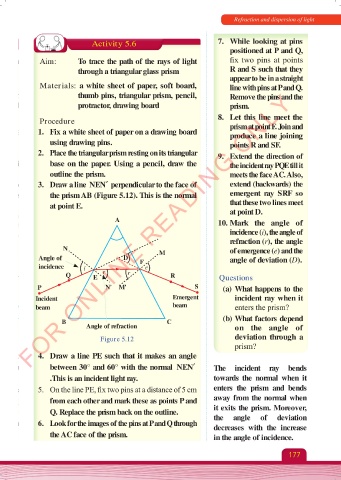
Activity 5.6 7. While looking at pins
positioned at P and Q,
Aim: To trace the path of the rays of light fix two pins at points
through a triangular glass prism R and S such that they
appear to be in a straight
Materials: a white sheet of paper, soft board, line with pins at P and Q.
FOR ONLINE READING ONLY
thumb pins, triangular prism, pencil, Remove the pins and the
protractor, drawing board prism.
Procedure 8. Let this line meet the
1. Fix a white sheet of paper on a drawing board prism at point F. Join and
produce a line joining
using drawing pins. points R and SF.
2. Place the triangular prism resting on its triangular 9. Extend the direction of
base on the paper. Using a pencil, draw the the incident ray PQE till it
outline the prism. meets the face AC. Also,
3. Draw a line NEN perpendicular to the face of extend (backwards) the
the prism AB (Figure 5.12). This is the normal emergent ray SRF so
at point E. that these two lines meet
at point D.
A 10. Mark the angle of
incidence (i), the angle of
refraction (r), the angle
N of emergence (e) and the
Angle of D F M angle of deviation (D).
incidence i e
Q E r r R Questions
P N' M' S (a) What happens to the
Incident Emergent incident ray when it
beam beam enters the prism?
B C (b) What factors depend
Angle of refraction on the angle of
Figure 5.12 deviation through a
prism?
4. Draw a line PE such that it makes an angle
between 30° and 60° with the normal NEN The incident ray bends
.This is an incident light ray. towards the normal when it
5. On the line PE, fix two pins at a distance of 5 cm enters the prism and bends
from each other and mark these as points P and away from the normal when
Q. Replace the prism back on the outline. it exits the prism. Moreover,
6. Look for the images of the pins at P and Q through the angle of deviation
decreases with the increase
the AC face of the prism. in the angle of incidence.
177
Physics Form 2 Final.indd 177 25/10/2025 10:28

