


Page 182 - Physics_Form_2
P. 182
Physics for Secondary Schools
Angle of deviation Now consider triangle MBC
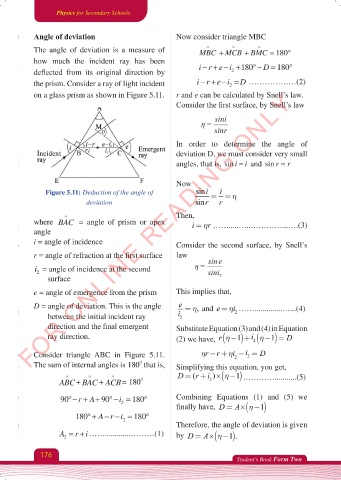
The angle of deviation is a measure of MBC MCB BMC 180
how much the incident ray has been
deflected from its original direction by i r ei 180 D 180
2
the prism. Consider a ray of light incident i r ei D ………………(2)
2
FOR ONLINE READING ONLY
on a glass prism as shown in Figure 5.11. r and e can be calculated by Snell’s law.
Consider the first surface, by Snell’s law
sini
η=
sinr
In order to determine the angle of
deviation D, we must consider very small
angles, that is, sinii and sin r r
Now
i
Figure 5.11: Deduction of the angle of sini = = η
deviation sinr r
Then,
where BAC = angle of prism or apex i = ηr …….....…..…………...….(3)
angle
i = angle of incidence Consider the second surface, by Snell’s
r = angle of refraction at the first surface law sine
i = angle of incidence at the second η= sini
2
surface 2
e = angle of emergence from the prism This implies that,
D = angle of deviation. This is the angle e = η, and e = ηi ……..............…...(4)
between the initial incident ray i 2 2
direction and the final emergent Substitute Equation (3) and (4) in Equation
ray direction. (2) we have, r η−1)+ i η−1)= D
2(
(
Consider triangle ABC in Figure 5.11. ηr −r +ηi − i = D
2
2
The sum of internal angles is 180 that is, Simplifying this equation, you get,
o
(
D = (r +i )× η−1)…………...........(5)
ABC + BAC + ACB = 180 o 2
i
90 rA 90 180 Combining Equations (1) and (5) we
2
(
finally have, D = A× η−1)
180 Ar i 180
2
Therefore, the angle of deviation is given
ri
(
A …….............………(1) by D = A× η−1).
2
176
Student’s Book Form Two
Physics Form 2 Final.indd 176 25/10/2025 10:28

