


Page 224 - Physics_Form_2
P. 224
Physics for Secondary Schools
objective lens and the angular magnification Solution
of the eyepiece. The final image is at infinity and two
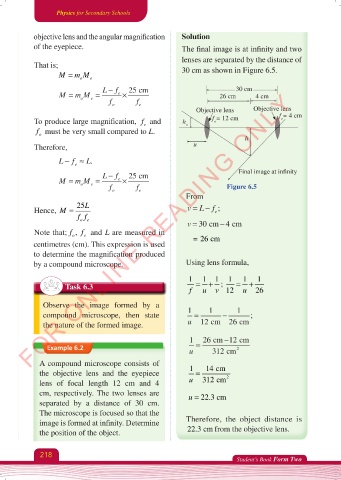
lenses are separated by the distance of
That is;
M = mM e 30 cm as shown in Figure 6.5.
o
L f 25 cm 30 cm
FOR ONLINE READING ONLY
M mM o e f e f 26 cm 4 cm
e
o
Objective lens Objective lens
e
To produce large magnification, f and h o f = 12 cm f = 4 cm
o
e
f must be very small compared to L. h
o
Therefore, u
L f e . L
L f 25 cm Final image at infinity
M mM o e e
f o f e Figure 6.5
From
25L
L
Hence, M = v e ; f
ff
o e
v 30 cm 4 cm
Note that; f o , f and L are measured in
e
centimetres (cm). This expression is used = 26 cm
to determine the magnification produced
by a compound microscope. Using lens formula,
1 1 1 1 1 1
;
Task 6.3 f = u + v 12 = u + 26
Observe the image formed by a 1 1 1
compound microscope, then state ;
the nature of the formed image. u 12 cm 26 cm
1 26 cm 12 cm
Example 6.2 u 312 cm 2
A compound microscope consists of 1 14 cm
the objective lens and the eyepiece = 2
lens of focal length 12 cm and 4 u 312 cm
cm, respectively. The two lenses are u = 22.3 cm
separated by a distance of 30 cm.
The microscope is focused so that the
image is formed at infinity. Determine Therefore, the object distance is
the position of the object. 22.3 cm from the objective lens.
218
Student’s Book Form Two
Physics Form 2 Final.indd 218 25/10/2025 10:28

