


Page 227 - Physics_Form_2
P. 227
Optical instruments

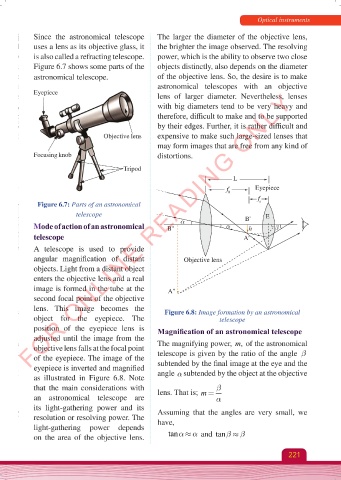
           Since the astronomical  telescope     The larger the diameter of the objective lens,
           uses a lens as its objective glass, it   the brighter the image observed. The resolving
           is also called a refracting telescope.   power, which is the ability to observe two close
           Figure 6.7 shows some parts of the    objects distinctly, also depends on the diameter
           astronomical telescope.               of the objective lens. So, the desire is to make
                                                 astronomical  telescopes  with an objective
          FOR ONLINE READING ONLY
           Eyepiece                              lens of larger diameter. Nevertheless,  lenses
                                                 with big diameters tend to be very heavy and
                                                 therefore, difficult to make and to be supported
                                                 by their edges. Further, it is rather difficult and
                                Objective lens   expensive to make such large-sized lenses that
                                                 may form images that are free from any kind of
           Focusing knob                         distortions.

                                      Tripod
                                                                        L
                                                                      f 0     Eyepiece
                                                                               f
            Figure 6.7: Parts of an astronomical                               e
                        telescope                                                E
                                                        α                  B'
           Mode of action of an astronomical        B''              α      h       β
           telescope                                                       A'
           A  telescope  is  used  to  provide
           angular  magnification  of  distant           Objective lens
           objects. Light from a distant object
           enters the objective lens and a real
           image is formed in the tube at the       A''
           second focal point of the objective
           lens.  This image becomes the           Figure 6.8: Image formation by an astronomical
           object  for the  eyepiece.  The                         telescope
           position of the eyepiece  lens is     Magnification of an astronomical telescope
           adjusted until the image from the
           objective lens falls at the focal point   The magnifying power,  ,m  of the astronomical
           of the eyepiece. The image of the     telescope is given by the ratio of the angle  β
           eyepiece is inverted and magnified    subtended by the final image at the eye and the
           as  illustrated  in  Figure  6.8.  Note   angle α subtended by the object at the objective
           that  the  main  considerations with                   β
           an astronomical  telescope are        lens. That is; m =  α
           its light-gathering power and its     Assuming that  the  angles  are  very  small,  we
           resolution or resolving power. The    have,
           light-gathering  power depends
           on the  area  of the  objective  lens.   tanα ≈ α  and  tanβ ≈ β

                                                                                        221


     Physics Form 2 Final.indd   221                                                        25/10/2025   10:28

