


Page 225 - Physics_Form_2
P. 225
Optical instruments

           Uses of a compound microscope                Materials: two convex lenses, hard
           Compound microscopes have a wide                         manila sheets (coloured
           range of applications in different aspects               black), scissors, cutter,
           of life.  Some of the applications  of
           compound microscopes include:                            rubber disc,  drill, a film
             (a) Viewing laboratory small samples                   canister or a small plastic
          FOR ONLINE READING ONLY
                such  as  tissues  and  body  fluids                container, plywood, a
                to check for infections caused by                   wooden stick
                microorganisms;
             (b) Studying micro-organisms and cells     Procedure
                in Biology experiments; and
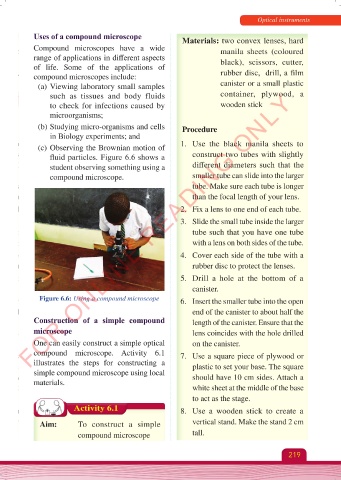
             (c) Observing the Brownian motion of       1.  Use the black manila sheets to
                fluid particles. Figure 6.6 shows a        construct two tubes with slightly
                student observing something using a        different diameters such that the
                compound microscope.                       smaller tube can slide into the larger
                                                           tube. Make sure each tube is longer
                                                           than the focal length of your lens.
                                                        2.  Fix a lens to one end of each tube.

                                                        3.  Slide the small tube inside the larger
                                                           tube such that you have one tube
                                                           with a lens on both sides of the tube.
                                                        4.  Cover each side of the tube with a
                                                           rubber disc to protect the lenses.

                                                        5.  Drill  a hole  at the bottom of  a
                                                           canister.
             Figure 6.6: Using a compound microscope    6.  Insert the smaller tube into the open
                                                           end of the canister to about half the
           Construction  of  a  simple  compound           length of the canister. Ensure that the
           microscope                                      lens coincides with the hole drilled
           One can easily construct a simple optical       on the canister.
           compound microscope.  Activity  6.1          7.  Use a square piece of plywood or
           illustrates  the  steps  for  constructing  a   plastic to set your base. The square
           simple compound microscope using local          should have 10 cm sides. Attach a
           materials.
                                                           white sheet at the middle of the base
                                                           to act as the stage.
                       Activity 6.1                     8.  Use a wooden stick to create a

             Aim:        To construct a simple             vertical stand. Make the stand 2 cm
                         compound microscope               tall.


                                                                                        219


     Physics Form 2 Final.indd   219                                                        25/10/2025   10:28

