


Page 45 - Physics_Form_2
P. 45
Current electricity
                              Chapter Two


                                  Current electricity

          FOR ONLINE READING ONLY


                Introduction

             Current electricity is a fundamental aspect of engineering science that is crucial for
             designing, analysing, and enhancing electric circuits, electronic devices, and power
             systems in various technological fields. In this chapter, you will learn the concepts
             of current electricity, voltage, Ohm’s law, electrical components, electrical energy
             and power. The competencies developed will enable you to design and make simple
             electric circuits for various applications. It will also enable you to utilise electrical
             appliances efficiently in various contexts.


                    Think
                           How would life on Earth be without electricity?


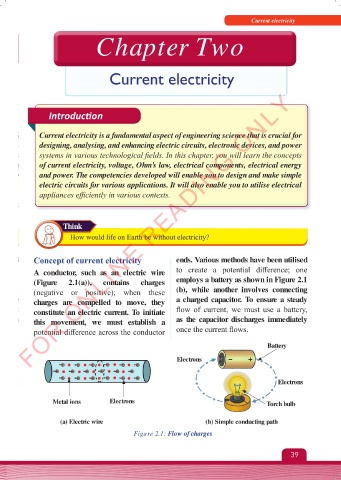
           Concept of current electricity             ends. Various methods have been utilised
           A conductor, such as an electric  wire     to  create  a  potential  difference;  one
           (Figure    2.1(a)),  contains    charges   employs a battery as shown in Figure 2.1
           (negative  or  positive);  when  these     (b), while  another  involves connecting
           charges are  compelled  to  move,  they    a charged capacitor. To ensure a steady
           constitute an electric current. To initiate   flow  of  current,  we  must  use  a  battery,
           this movement, we must establish a         as the capacitor discharges immediately
           potential difference across the conductor   once the current flows.
                                                                                  Battery

                                                      Electrons


                                                                                     Electrons


                 Metal ions       Electrons                                       Torch bulb


                   (a) Electric wire                                                              (b) Simple conducting path
                                         Figure 2.1: Flow of charges


                                                                                         39


     Physics Form 2 Final.indd   39                                                         25/10/2025   10:25

