


Page 46 - Physics_Form_2
P. 46
Physics for Secondary Schools
Electric current (I) is defined as the rate Electromotive force
of flow of electric charge (Q) through a The electromotive force (e.m.f) is the
conductor over time (t). This relationship potential difference across the terminals
is expressed mathematically as of a source when no current is flowing.
charge(Q) It provides the energy required to move
I= electrons through a conductor, leading to an
FOR ONLINE READING ONLY
time(t)
electric current. Note that the word “force”
in this case does not mean the force of
But, Q = ne ,
interaction between bodies. One may draw
an analogy of e.m.f to water pressure. When
where n is the number of electrons and e
is the charge of an electron. the pressure is high, more water flows
through a pipe. Similarly, with higher e.m.f,
Therefore, more electrons flow through a conductor.
Sources of e.m.f include electrochemical
ne cells such as dry cells and car batteries,
I =
t thermoelectric devices, solar cells and
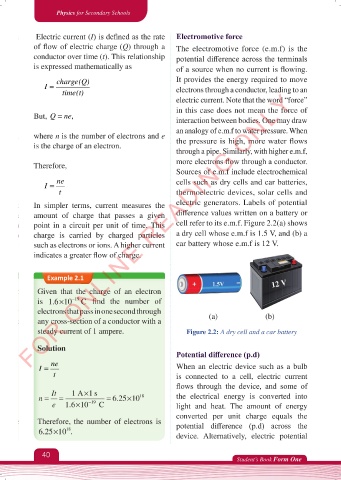
In simpler terms, current measures the electric generators. Labels of potential
amount of charge that passes a given difference values written on a battery or
point in a circuit per unit of time. This cell refer to its e.m.f. Figure 2.2(a) shows
charge is carried by charged particles a dry cell whose e.m.f is 1.5 V, and (b) a
such as electrons or ions. A higher current car battery whose e.m.f is 12 V.
indicates a greater flow of charge.
Example 2.1 12 V
Given that the charge of an electron
is 1.6 10 19 C find the number of
electrons that pass in one second through
any cross-section of a conductor with a (a) (b)
steady current of 1 ampere. Figure 2.2: A dry cell and a car battery
Solution
Potential difference (p.d)
ne
I = When an electric device such as a bulb
t is connected to a cell, electric current
flows through the device, and some of
It 1 A 1s
n 6.25 10 18 the electrical energy is converted into
e 1.6 10 19 C light and heat. The amount of energy
converted per unit charge equals the
Therefore, the number of electrons is potential difference (p.d) across the
6.25 10 . 18
device. Alternatively, electric potential
40
Student’s Book Form One
Physics Form 2 Final.indd 40 25/10/2025 10:25

