


Page 193 - Computer_Science_F5
P. 193
Computer Science  between the sender and receiver is done with the help of a satellite. The signal,
           which is a beam of modulated microwaves, is sent toward the satellite. Then the
           satellite amplifies the signal and sends it back to the receiver’s antenna present on
           the earth’s surface. So, all the signal transferring is happening in space. Thus, this
           type of communication is known as space communication. Some of the properties
          FOR ONLINE READING ONLY
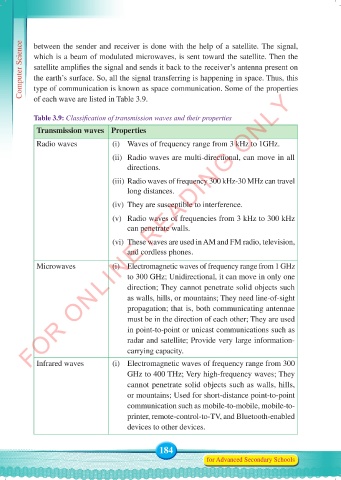
           of each wave are listed in Table 3.9.

           Table 3.9: Classification of transmission waves and their properties

            Transmission waves Properties
            Radio waves            (i)  Waves of frequency range from 3 kHz to 1GHz.

                                   (ii)  Radio waves are multi-directional, can move in all
                                        directions.
                                   (iii) Radio waves of frequency 300 kHz-30 MHz can travel
                                        long distances.

                                   (iv)  They are susceptible to interference.
                                   (v)  Radio waves of frequencies from 3 kHz to 300 kHz
                                        can penetrate walls.

                                   (vi)  These waves are used in AM and FM radio, television,
                                        and cordless phones.

            Microwaves             (i)  Electromagnetic waves of frequency range from 1 GHz
                                        to 300 GHz; Unidirectional, it can move in only one
                                        direction; They cannot penetrate solid objects such
                                        as walls, hills, or mountains; They need line-of-sight
                                        propagation; that is, both communicating antennae
                                        must be in the direction of each other; They are used
                                        in point-to-point or unicast communications such as
                                        radar and satellite; Provide very large information-
                                        carrying capacity.

            Infrared waves         (i)  Electromagnetic waves of frequency range from 300
                                        GHz to 400 THz; Very high-frequency waves; They
                                        cannot penetrate solid objects such as walls, hills,
                                        or mountains; Used for short-distance point-to-point
                                        communication such as mobile-to-mobile, mobile-to-
                                        printer, remote-control-to-TV, and Bluetooth-enabled
                                        devices to other devices.


                                                 184
                                                                for Advanced Secondary Schools


     Computer Science Form 5.indd   184                                                     23/07/2024   12:33

