


Page 232 - Computer_Science_F5
P. 232
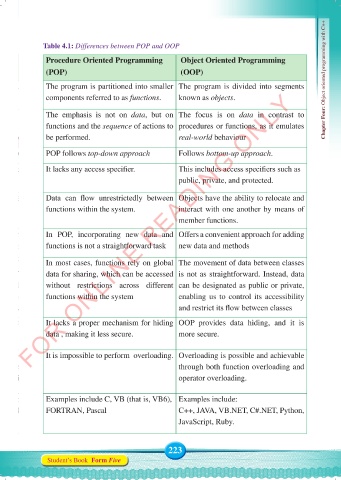
Table 4.1: Differences between POP and OOP
               Procedure Oriented Programming           Object Oriented Programming

               (POP)                                    (OOP)
               The program is partitioned into smaller  The program is divided into segments       Chapter Four: Object oriented programming with C++
          FOR ONLINE READING ONLY
               components referred to as functions.    known as objects.


               The emphasis is not on  data, but on  The focus is on data in contrast  to
               functions and the sequence of actions to  procedures or functions, as it emulates
               be performed.                           real-world behaviour

               POP follows top-down approach           Follows bottom-up approach.

               It lacks any access specifier.          This includes access specifiers such as
                                                       public, private, and protected.

               Data  can  flow  unrestrictedly  between  Objects have the ability to relocate and
               functions within the system.            interact with one another by means of

                                                       member functions.
               In POP, incorporating  new data  and  Offers a convenient approach for adding
               functions is not a straightforward task  new data and methods


               In most cases, functions rely on global  The movement of data between classes
               data for sharing, which can be accessed  is not as straightforward. Instead, data
               without restrictions across different  can be designated as public or private,
               functions within the system             enabling us to control its accessibility
                                                       and restrict its flow between classes

               It lacks a proper mechanism for hiding  OOP provides data  hiding, and it is
               data , making it less secure.           more secure.


               It is impossible to perform  overloading. Overloading is possible and achievable
                                                       through both function overloading and
                                                       operator overloading.


               Examples include C, VB (that is, VB6), Examples include:
               FORTRAN, Pascal                         C++, JAVA, VB.NET, C#.NET, Python,

                                                       JavaScript, Ruby.


                                                    223
               Student’s Book  Form Five


     Computer Science Form 5.indd   223                                                     23/07/2024   12:33

