


Page 98 - Theatre_Arts_Form_5
P. 98
Theatre Arts for Advanced Secondary Schools


            Imagination
            In the imagination aspect, the actors are trained to use imaginative faculties rather
            than trying to copy reality. Stanislaviski believed that there is no such a thing as
            actuality on the stage and that art is a product of imagination. Through imagination
            technique, Stanislavski helped his actors to understand the acting purpose which
        FOR ONLINE READING ONLY
            is to turn the play into a theatrical reality. The richness of actor’s imagination
            would always make the performance more interesting in terms of objectives,
            physical action and in creating given circumstances around the character.

            Inner motive forces
            In  this  approach,  Stanislavski  insisted  on  training  actors  to  find  motivation
            either driven by emotions or by the mind to choose physical actions. Motivation
            arouses the ‘will’ of the actor to perform the given actions.  Thus, the ‘will’
            became activated indirectly through either emotions or the mind. He considered
            that to be eager to act with excitement and animation, the actor must possess
            three movers of psych and soul of acting life. These movers are: artistic wish,
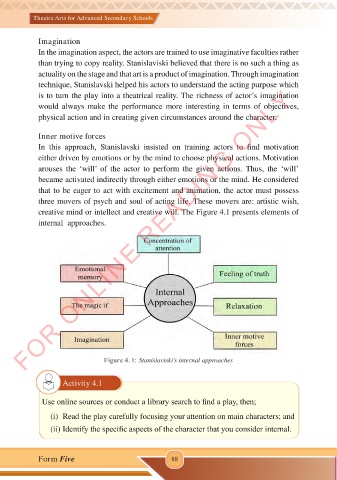
            creative mind or intellect and creative will. The Figure 4.1 presents elements of
            internal  approaches.


                                Figure 4. 1: Stanislaviski’s internal approaches


                    Activity 4.1

             Use online sources or conduct a library search to find a play, then;

                (i)  Read the play carefully focusing your attention on main characters; and
                (ii) Identify the specific aspects of the character that you consider internal.


            Form Five                               88


                                                                                          28/06/2024   15:05
   THEATRE ART F5 fnl.indd   88                                                           28/06/2024   15:05
   THEATRE ART F5 fnl.indd   88

