


Page 100 - Theatre_Arts_Form_5
P. 100
Theatre Arts for Advanced Secondary Schools


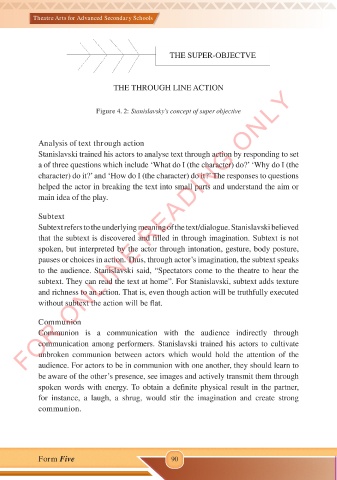
                                                   THE SUPER-OBJECTVE


        FOR ONLINE READING ONLY
                                   THE THROUGH LINE ACTION


                             Figure 4. 2: Stanislavsky’s concept of super objective


            Analysis of text through action
            Stanislavski trained his actors to analyse text through action by responding to set
            a of three questions which include ‘What do I (the character) do?’ ‘Why do I (the
            character) do it?’ and ‘How do I (the character) do it?’ The responses to questions
            helped the actor in breaking the text into small parts and understand the aim or
            main idea of the play.


            Subtext
            Subtext refers to the underlying meaning of the text/dialogue. Stanislavski believed
            that the subtext is discovered and filled in through imagination. Subtext is not
            spoken, but interpreted by the actor through intonation, gesture, body posture,
            pauses or choices in action. Thus, through actor’s imagination, the subtext speaks
            to the audience. Stanislavski said, “Spectators come to the theatre to hear the
            subtext. They can read the text at home”. For Stanislavski, subtext adds texture
            and richness to an action. That is, even though action will be truthfully executed
            without subtext the action will be flat.

            Communion
            Communion is a communication  with the audience indirectly  through
            communication among performers. Stanislavski trained his actors to cultivate
            unbroken  communion  between  actors  which  would  hold  the  attention  of the
            audience. For actors to be in communion with one another, they should learn to
            be aware of the other’s presence, see images and actively transmit them through
            spoken words with energy. To obtain a definite physical result in the partner,
            for instance,  a laugh, a shrug, would stir the imagination  and create  strong
            communion.


            Form Five                               90


                                                                                          28/06/2024   15:05
   THEATRE ART F5 fnl.indd   90                                                           28/06/2024   15:05
   THEATRE ART F5 fnl.indd   90

