


Page 200 - Agriculture_Form_3
P. 200
Agriculture for Secondary Schools


              linked to cultural life in many parts of Tanzania. They are used in payment of
              dowry, traditional ceremonies, and as symbols of wealth and respect in society.
              Beef cattle production contributes to household income and employment. Sales of
              live animals or meat generate money to cater for basic needs such as school fees,
          FOR ONLINE READING ONLY
              clothes and medical care. The beef value chain involves farmers, butchers, meat
              vendors, transporters and input suppliers. Thus, creating many job opportunities.
              As more people migrate to towns and eating habits change, the demand for beef
              keeps growing. This makes beef cattle production an important part to propel
              rural development and youth employment.

               Systems for raising beef cattle

              There are three main systems for rearing beef cattle they include the extensive,
              semi-intensive, and intensive systems. These systems differ in land use, feeding
              methods, and level of control over cattle management. However, they are not
              equally  practised  across the  country.  The  extensive  system,  also  known as
              pastoralism,  is the most widely used in Tanzania.  It accounts  for about 94%
              of the total beef cattle herds and contributes around 95% of the national beef
              supply. Under this system, cattle graze freely on open natural rangelands. Cattle
              movements from place to place is common as herds follow seasonal changes in
              grass and water availability. Animal health and feeding are not properly managed,
              and animal growth tends to be slow. This system is common in semi-arid areas
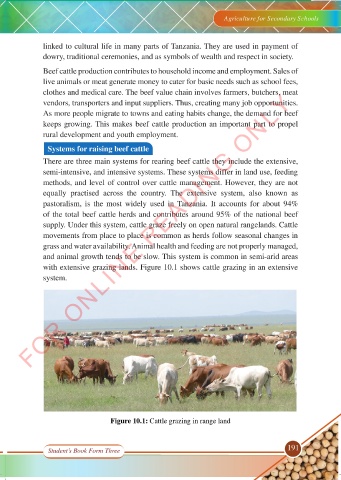
              with extensive grazing lands. Figure 10.1 shows cattle grazing in an extensive
              system.


                                  Figure 10.1: Cattle grazing in range land


                Student’s Book Form Three                                               191


                                                                                            17/09/2025   14:12
     AGRICULTURE F3.indd   191                                                              17/09/2025   14:12
     AGRICULTURE F3.indd   191

