


Page 201 - Agriculture_Form_3
P. 201
Agriculture for Secondary Schools


              The remaining 6% of beef cattle herds in Tanzania are managed under improved
              systems, which include both semi-intensive and intensive systems. The semi-
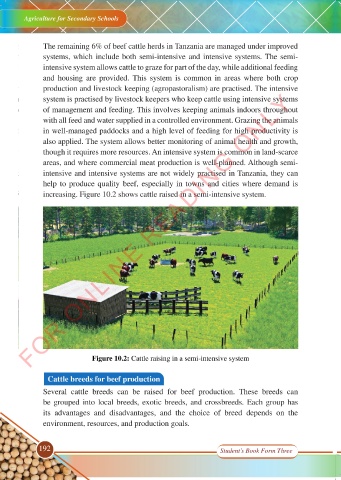
              intensive system allows cattle to graze for part of the day, while additional feeding
              and housing are provided. This system is common  in areas where both crop
              production and livestock keeping (agropastoralism) are practised. The intensive
          FOR ONLINE READING ONLY
              system is practised by livestock keepers who keep cattle using intensive systems
              of management and feeding. This involves keeping animals indoors throughout
              with all feed and water supplied in a controlled environment. Grazing the animals
              in well-managed paddocks and a high level of feeding for high productivity is
              also applied. The system allows better monitoring of animal health and growth,
              though it requires more resources. An intensive system is common in land-scarce
              areas, and where commercial meat production is well-planned. Although semi-
              intensive and intensive systems are not widely practised in Tanzania, they can
              help to produce quality beef, especially in towns and cities where demand is
              increasing. Figure 10.2 shows cattle raised in a semi-intensive system.


                             Figure 10.2: Cattle raising in a semi-intensive system


               Cattle breeds for beef production
              Several  cattle breeds can be raised for beef production.  These breeds can
              be grouped into local breeds, exotic breeds, and crossbreeds. Each group has
              its advantages and disadvantages,  and the  choice  of breed depends on the
              environment, resources, and production goals.


             192                                                    Student’s Book Form Three


                                                                                            17/09/2025   14:12
     AGRICULTURE F3.indd   192                                                              17/09/2025   14:12
     AGRICULTURE F3.indd   192

