


Page 96 - Bisiness Studies_Form_3
P. 96
Business Studies for Secondary Schools


          Ethical norms and values are standards and guidelines that encourage moral behaviour.
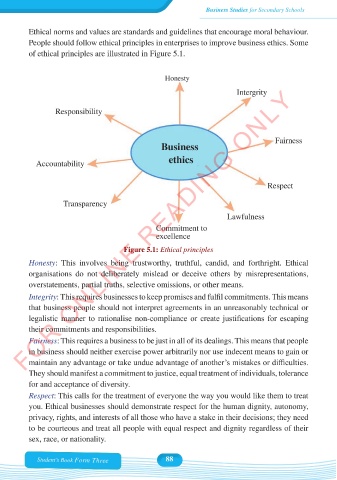
          People should follow ethical principles in enterprises to improve business ethics. Some
          of ethical principles are illustrated in Figure 5.1.


                                                  Honesty
        FOR ONLINE READING ONLY
                                                                       Intergrity


                 Responsibility


                                                                                  Fairness
                                                 Business

            Accountability                         ethics


                                                                                Respect

                    Transparency

                                                                    Lawfulness
                                               Commitment to
                                               excellence

                                      Figure 5.1: Ethical principles
          Honesty:  This  involves  being  trustworthy, truthful,  candid,  and  forthright.  Ethical
          organisations do not deliberately  mislead  or deceive  others by misrepresentations,
          overstatements, partial truths, selective omissions, or other means.

          Integrity: This requires businesses to keep promises and fulfil commitments. This means
          that business people should not interpret agreements in an unreasonably technical or
          legalistic manner to rationalise non-compliance or create justifications for escaping
          their commitments and responsibilities.
          Fairness: This requires a business to be just in all of its dealings. This means that people
          in business should neither exercise power arbitrarily nor use indecent means to gain or
          maintain any advantage or take undue advantage of another’s mistakes or difficulties.
          They should manifest a commitment to justice, equal treatment of individuals, tolerance
          for and acceptance of diversity.
          Respect: This calls for the treatment of everyone the way you would like them to treat
          you. Ethical businesses should demonstrate respect for the human dignity, autonomy,
          privacy, rights, and interests of all those who have a stake in their decisions; they need
          to be courteous and treat all people with equal respect and dignity regardless of their
          sex, race, or nationality.


            Student’s Book Form Three             88

