


Page 134 - Biology Form Two
P. 134
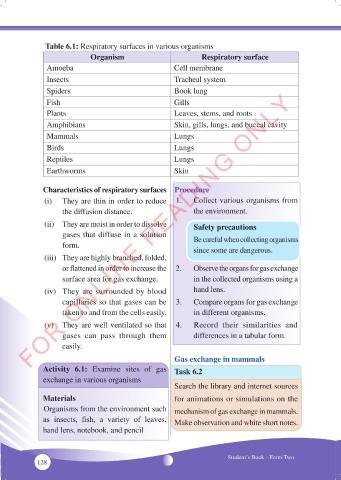
Table 6.1: Respiratory surfaces in various organisms
                            Organism                          Respiratory surface
               Amoeba                                 Cell membrane
               Insects                                Tracheal system
          FOR ONLINE READING ONLY
               Spiders                                Book lung
               Fish                                   Gills
               Plants                                 Leaves, stems, and roots
               Amphibians                             Skin, gills, lungs, and buccal cavity

               Mammals                                Lungs
               Birds                                  Lungs
               Reptiles                               Lungs
               Earthworms                             Skin


              Characteristics of respiratory surfaces  Procedure
              (i)   They are thin in order to reduce  1.    Collect various organisms from
                    the diffusion distance.                 the environment.
              (ii)  They are moist in order to dissolve      Safety precautions
                    gases that diffuse in a solution        Be careful when collecting organisms
                    form.                                   since some are dangerous.

              (iii)  They are highly branched, folded,
                    or flattened in order to increase the  2.   Observe the organs for gas exchange
                    surface area for gas exchange.          in the collected organisms using a
              (iv)  They are surrounded by blood            hand lens.
                    capillaries so that gases can be  3.    Compare organs for gas exchange
                    taken to and from the cells easily.     in different organisms.
              (v)  They are well ventilated so that  4.     Record their similarities  and
                    gases can pass through them             differences in a tabular form.
                    easily.

                                                      Gas exchange in mammals
              Activity  6.1:  Examine  sites  of gas   Task 6.2
              exchange in various organisms
                                                      Search the library and internet sources
              Materials                               for animations or simulations on the
              Organisms from the environment such     mechanism of gas exchange in mammals.
              as  insects,  fish,  a  variety  of  leaves,   Make observation and white short notes.
              hand lens, notebook, and pencil


                                                                      Student’s Book - Form Two
            128


                                                                                          05/10/2024   15:36:42
     BIOLOGY FORM 2 NEW.indd   128
     BIOLOGY FORM 2 NEW.indd   128                                                        05/10/2024   15:36:42

