


Page 138 - Biology Form Two
P. 138
Biology for Secondary Schools


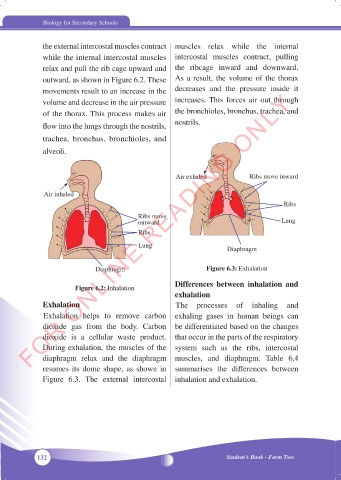
              the external intercostal muscles contract  muscles relax while the internal
              while the internal intercostal muscles  intercostal  muscles contract,  pulling
              relax and pull the rib cage upward and  the  ribcage  inward and downward.
              outward, as shown in Figure 6.2. These   As a result, the volume of the thorax
              movements result to an increase in the   decreases and the pressure inside it
                                           LungREADING ONLY
              volume and decrease in the air pressure   increases. This  forces air  out  through
              of the thorax. This process makes air   the bronchioles, bronchus, trachea, and

              flow into the lungs through the nostrils,   nostrils.
              trachea, bronchus, bronchioles, and

              alveoli.


                                                      Air exhaled            Ribs move inward


              Air inhaled
                                                                                       Ribs
                                           Ribs move
                                           outward                                    Lung
                                           Ribs
          FOR ONLINE
                                                                      Diaphragm


                              Diaphragm                        Figure 6.3: Exhalation

                                                      Differences between inhalation and
                        Figure 6.2: Inhalation
                                                      exhalation
              Exhalation                              The  processes of inhaling  and

              Exhalation helps to remove  carbon  exhaling  gases in human beings can
              dioxide gas from the body. Carbon  be differentiated based on the changes
              dioxide  is a  cellular  waste  product.  that occur in the parts of the respiratory
              During exhalation, the muscles of the  system  such  as  the  ribs,  intercostal
              diaphragm  relax  and  the  diaphragm  muscles,  and diaphragm.  Table  6.4
              resumes its dome shape, as shown in  summarises  the  differences  between
              Figure  6.3.  The  external intercostal  inhalation and exhalation.


            132                                                      Student’s Book - Form Two


                                                                                          05/10/2024   15:36:43
     BIOLOGY FORM 2 NEW.indd   132                                                        05/10/2024   15:36:43
     BIOLOGY FORM 2 NEW.indd   132

