


Page 136 - Biology Form Two
P. 136
Biology for Secondary Schools


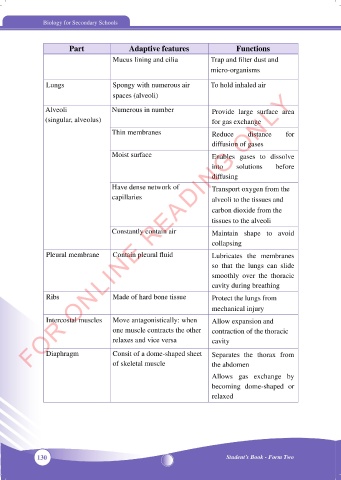
                      Part              Adaptive features               Functions
                                   Mucus lining and cilia        Trap and filter dust and
                                                                 micro-organisms

               Lungs               Spongy with numerous air      To hold inhaled air
          FOR ONLINE READING ONLY
                                   spaces (alveoli)

               Alveoli             Numerous in number            Provide large surface area
               (singular, alveolus)                              for gas exchange
                                   Thin membranes                Reduce     distance   for
                                                                 diffusion of gases
                                   Moist surface                 Enables gases to dissolve
                                                                 into   solutions   before
                                                                 diffusing
                                   Have dense network of         Transport oxygen from the
                                   capillaries                   alveoli to the tissues and

                                                                 carbon dioxide from the
                                                                 tissues to the alveoli
                                   Constantly contain air        Maintain  shape to avoid
                                                                 collapsing
               Pleural membrane    Contain pleural fluid         Lubricates  the membranes
                                                                 so that  the  lungs can slide
                                                                 smoothly over the thoracic
                                                                 cavity during breathing
               Ribs                Made of hard bone tissue      Protect the lungs from
                                                                 mechanical injury

               Intercostal muscles   Move antagonistically: when   Allow expansion and
                                   one muscle contracts the other   contraction of the thoracic
                                   relaxes and vice versa        cavity

               Diaphragm           Consit of a dome-shaped sheet   Separates the thorax from
                                   of skeletal muscle            the abdomen
                                                                 Allows gas exchange by
                                                                 becoming dome-shaped or
                                                                 relaxed


            130                                                      Student’s Book - Form Two


                                                                                          05/10/2024   15:36:43
     BIOLOGY FORM 2 NEW.indd   130                                                        05/10/2024   15:36:43
     BIOLOGY FORM 2 NEW.indd   130

