


Page 139 - Biology Form Two
P. 139
Biology for Secondary Schools


               Table 6.4:   Differences between inhalation and exhalation
                            Inhalation                            Exhalation
               (i)  External intercostal muscles contract  (i)  External intercostal muscles relax
               (ii)  Internal intercostal muscles relax   (ii)  Internal intercostal muscles contract
          FOR ONLINE READING ONLY
               (iii)  The  ribcage  moves  outward  and  (iii)  The  ribcage  moves  inward  and
                    upward                                downward
               (iv)  The diaphragm contracts and flattens  (iv)  The diaphragm relaxes and becomes
                                                          dome-shaped
               (v)  The volume of the thoracic cavity  (v)  The volume of the thoracic cavity
                    increases  as the  pressure decreases.   decreases as pressure increases. This
                    This allows air to enter the lungs    forces air out of the lungs
               (vi)  Air enters the  alveoli  through the  (vi)  Air leaves the alveoli through
                    nostrils,  pharynx, glottis,  trachea,   the  bronchioles,  trachea,  glottis,
                    bronchioles, and finally alveoli      pharynx, and finally nostrils


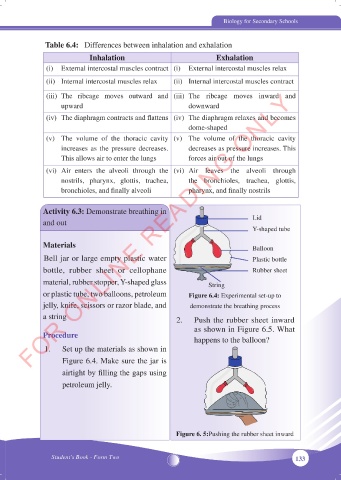
              Activity 6.3: Demonstrate breathing in
              and out                                                        Lid
                                                                             Y-shaped tube

              Materials                                                      Balloon

              Bell jar or large empty plastic water                          Plastic bottle
              bottle,  rubber sheet or cellophane                            Rubber sheet
              material, rubber stopper, Y-shaped glass          String
              or plastic tube, two balloons, petroleum    Figure 6.4: Experimental set-up to

              jelly, knife, scissors or razor blade, and   demonstrate the breathing process
              a string                                2.    Push the rubber sheet inward
                                                            as shown in Figure 6.5. What
              Procedure                                     happens to the balloon?

              1.    Set up the materials as shown in
                    Figure 6.4. Make sure the jar is
                    airtight by filling the gaps using

                    petroleum jelly.


                                                      Figure 6. 5:Pushing the rubber sheet inward


                 Student’s Book - Form Two                                                133


                                                                                          05/10/2024   15:36:43
     BIOLOGY FORM 2 NEW.indd   133
     BIOLOGY FORM 2 NEW.indd   133                                                        05/10/2024   15:36:43

