


Page 135 - Biology Form Two
P. 135
Biology for Secondary Schools


              Gas exchange is process that enables mammals to obtain oxygen gas in their
              body for respiration. Gas exchange is possible through the respiratory system.
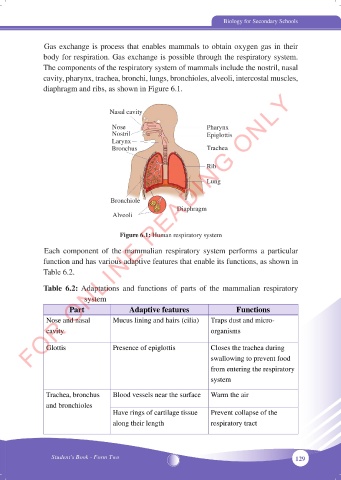
              The components of the respiratory system of mammals include the nostril, nasal
              cavity, pharynx, trachea, bronchi, lungs, bronchioles, alveoli, intercostal muscles,
              diaphragm and ribs, as shown in Figure 6.1.
          FOR ONLINE READING ONLY

                                  Nasal cavity

                                   Nose                         Pharynx
                                   Nostril                      Epiglottis
                                   Larynx
                                   Bronchus                     Trachea

                                                                Rib

                                                                Lung


                                  Bronchiole
                                                       Diaphragm
                                   Alveoli


                                     Figure 6.1: Human respiratory system
              Each  component  of the mammalian  respiratory  system performs a particular
              function and has various adaptive features that enable its functions, as shown in
              Table 6.2.

              Table 6.2: Adaptations  and functions of parts of the mammalian  respiratory
                           system

                      Part              Adaptive features                Functions
               Nose and nasal      Mucus lining and hairs (cilia)  Traps dust and micro-
               cavity                                            organisms

               Glottis             Presence of epiglottis        Closes the trachea during
                                                                 swallowing to prevent food
                                                                 from entering the respiratory
                                                                 system

               Trachea, bronchus   Blood vessels near the surface   Warm the air
               and bronchioles
                                   Have rings of cartilage tissue   Prevent collapse of the
                                   along their length            respiratory tract


                 Student’s Book - Form Two                                                129


                                                                                          05/10/2024   15:36:42
     BIOLOGY FORM 2 NEW.indd   129                                                        05/10/2024   15:36:42
     BIOLOGY FORM 2 NEW.indd   129

