


Page 34 - Biology Form Two
P. 34
Biology for Secondary Schools


              Questions                               (ii)  they are insoluble in water.
              1.    What colour changes did you             (When put in water they form a
                    observe?                                suspension);
              2.    What effect did hydrochloric acid   (iii)  they coagulate when boiled in
          FOR ONLINE READING ONLY
                    have on sucrose?                        water; and
              3.    Why was the sodium hydroxide      (iv)  when mixed with iodine solution
                    solution or sodium bicarbonate          starch  changes  colour  to  blue
                    solution added to the mixture?          black.


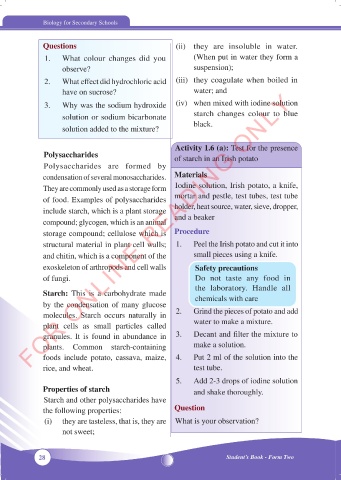
                                                      Activity 1.6 (a): Test for the presence
              Polysaccharides                         of starch in an Irish potato
              Polysaccharides are formed by
              condensation of several monosaccharides.   Materials

              They are commonly used as a storage form   Iodine solution, Irish potato, a knife,
              of food. Examples of polysaccharides    mortar and pestle, test tubes, test tube
              include starch, which is a plant storage   holder, heat source, water, sieve, dropper,
              compound; glycogen, which is an animal   and a beaker
              storage compound; cellulose which is    Procedure
              structural material in plant cell walls;  1.   Peel the Irish potato and cut it into
              and chitin, which is a component of the       small pieces using a knife.

              exoskeleton of arthropods and cell walls      Safety precautions
              of fungi.                                     Do not taste any food in
                                                            the laboratory. Handle all
              Starch:  This is a carbohydrate  made         chemicals with care
              by the condensation of many glucose
              molecules.  Starch occurs naturally  in   2.   Grind the pieces of potato and add
              plant  cells as small  particles  called      water to make a mixture.
              granules.  It  is found in  abundance  in   3.   Decant and filter the mixture to
              plants. Common starch-containing              make a solution.
              foods  include potato, cassava, maize,  4.    Put 2 ml of the solution into the
              rice, and wheat.                              test tube.

                                                      5.    Add 2-3 drops of iodine solution
              Properties of starch                          and shake thoroughly.
              Starch and other polysaccharides have
              the following properties:               Question
              (i)   they are tasteless, that is, they are  What is your observation?
                    not sweet;


             28                                                      Student’s Book - Form Two


                                                                                          05/10/2024   15:36:20
     BIOLOGY FORM 2 NEW.indd   28                                                         05/10/2024   15:36:20
     BIOLOGY FORM 2 NEW.indd   28

