


Page 122 - Chemistry_Form_2
P. 122
Chemistry
                                                                           for Secondary Schools


              Preventing formation of acid rain
              When the pH of rainwater falls below 5.6, it is called acid rain. Acid rain is
              caused by chemical reactions between rainwater and gases such as sulfur dioxide
              and nitrogen dioxide which are released into the atmosphere. Acid rain increases
              the acidity of soils, rivers and lakes and adversely affects vegetation and aquatic
          FOR ONLINE READING ONLY
              organisms. To reduce this problem, air pollution devices containing bases are
              fitted in exhaust pipes and chimneys to neutralise the acidic compounds before
              reaching the atmosphere.

              Neutralising accidental spills

              If an acid or an alkali spills on the floor or work surface in the laboratory, it
              can be neutralised. For example, sulfuric acid which is very corrosive, can be
              neutralised by adding sodium hydroxide.

              Manufacturing fertilisers

              The production of ammonium fertilisers is done through the neutralisation of
              ammonia with a mineral acid. Ammonium nitrate for example, is produced by the
              reaction of ammonia with nitric acid.


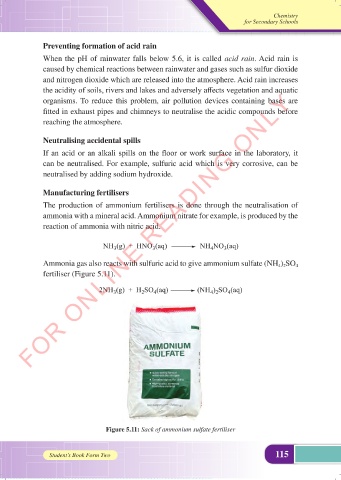
              Ammonia gas also reacts with sulfuric acid to give ammonium sulfate (NH 4 ) 2 SO 4
              fertiliser (Figure 5.11).


                                 Figure 5.11: Sack of ammonium sulfate fertiliser


                Student’s Book Form Two                                             115


                                                                                          01/08/2025   11:21:06
     CHEMISTRY FORM TWO NEW 2025 DUMMY.indd   115                                         01/08/2025   11:21:06
     CHEMISTRY FORM TWO NEW 2025 DUMMY.indd   115

