


Page 119 - Chemistry_Form_2
P. 119
Chemistry
              for Secondary Schools


              To identify the end point for an acid-base reaction, an indicator must be added.
              For example, when phenolphthalein indicator is used in a particular titration (by
              running the acid from a burette to a base in a flask), the pink colour of the content
              in the flask starts to change slowly to colourless. The end point is marked when
              the reaction mixture in the flask just turns colourless. During neutralisation of
          FOR ONLINE READING ONLY
              a base with an acid, the volume of the base in a flask is normally known. The
              volume of the acid that has neutralised the alkali is called a titre value or titre
              volume.
              To get the exact volume (V) of the acid that neutralises a base, the initial burette
              reading, V  is subtracted from the final burette reading V 2 .
                        1
                                               V = V 2  – V 1

                       Activity 5.3


              Aim: To investigate the neutralisation reaction between sodium hydroxide and
                    dilute hydrochloric acid

              Requirements:  Pipette, burette, retort stand and clamp, 10-mL measuring
                              cylinder, conical flasks, beakers, evaporating dish, white tile,
                              heat source, tripod stand, wire gauze, 0.1 M sodium hydroxide,
                              0.1 M hydrochloric acid, and phenolphthalein indicator
               Procedure
                1.  Transfer 25 cm (or 20 cm ) of sodium hydroxide solution into a conical
                                             3
                                  3
                   flask by using a pipette.
                2.  Add  2 to 3 drops of phenolphthalein indicator to the solution.

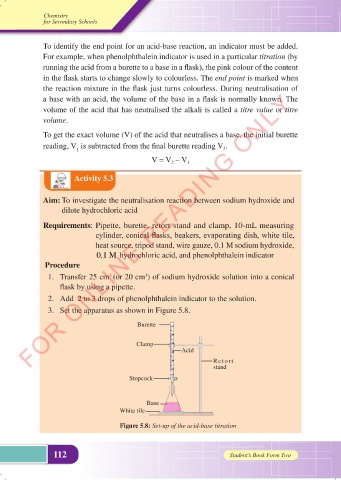
                3.  Set the apparatus as shown in Figure 5.8.
                                          Burette


                                          Clamp
                                                        Acid
                                                                 Retort
                                                                 stand

                                        Stopcock


                                             Base
                                     White tile

                                     Figure 5.8: Set-up of the acid-base titration


                 112                                                  Student’s Book Form Two


                                                                                          01/08/2025   11:21:05
     CHEMISTRY FORM TWO NEW 2025 DUMMY.indd   112
     CHEMISTRY FORM TWO NEW 2025 DUMMY.indd   112                                         01/08/2025   11:21:05

