


Page 123 - Chemistry_Form_2
P. 123
Chemistry
              for Secondary Schools


              Uses of acids and bases

                  Task 5.4
              Explore reliable books, online, or  home  resources to identify three everyday
              products containing acids and three containing bases.
          FOR ONLINE READING ONLY
              For each product or material you find:
               1.  Write the trade name, common name and chemical name of the product.

               2.  Identify the acid or base it contains (if known).
               3.  Describe its use or purpose in daily life.


              Acids and bases have many uses in daily life. For instance, some plants grow well
              in acidic soil, but others grow better in a neutral or alkaline soil. Farmers need
              to know the pH of the soil because the soil can be too acidic causing inability of
              plants to grow well and reduce the yields. Bases can be used by farmers to reduce
              the acidity of the soil, and acids can be used to correct the pH for the basic soils.


              Amino acids and some vitamins such as vitamin C are important for our health.
              Sulfuric acid is used in car batteries. Citric acid is used in food preservation. Bases
              such as sodium hypochlorite are used in bleaching to remove stains on clothes.
              Ammonium hydroxide is used as a glass cleaner, and magnesium hydroxide is
              used as a laxative to regulate bowel movements. Magnesium hydroxide is also
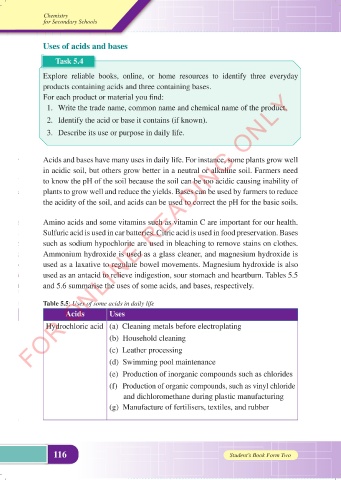
              used as an antacid to relieve indigestion, sour stomach and heartburn. Tables 5.5
              and 5.6 summarise the uses of some acids, and bases, respectively.

              Table 5.5: Uses of some acids in daily life
                     Acids        Uses

               Hydrochloric acid (a)  Cleaning metals before electroplating
                                  (b)  Household cleaning
                                  (c)  Leather processing
                                  (d)  Swimming pool maintenance

                                  (e)  Production of inorganic compounds such as chlorides
                                  (f)   Production of organic compounds, such as vinyl chloride
                                         and dichloromethane during plastic manufacturing
                                  (g)  Manufacture of fertilisers, textiles, and rubber


                 116                                                  Student’s Book Form Two


                                                                                          01/08/2025   11:21:06
     CHEMISTRY FORM TWO NEW 2025 DUMMY.indd   116                                         01/08/2025   11:21:06
     CHEMISTRY FORM TWO NEW 2025 DUMMY.indd   116

