


Page 114 - Chemistry_Form_2
P. 114
Chemistry
                                                                           for Secondary Schools


              Metal oxides are those compounds which contain a metal and an oxygen atom.
              Examples of metal oxides include sodium oxide, Na 2 O; potassium oxide, K 2 O;
              calcium oxide, CaO; magnesium oxide, MgO; and copper(II) oxide, CuO.

              Hydroxides are those compounds which contain a hydroxy group ( ̶ OH). Examples

              of  hydroxides include  calcium  hydroxide, Ca(OH) 2 ;  magnesium  hydroxide,
          FOR ONLINE READING ONLY
              Mg(OH) 2 ; sodium hydroxide, NaOH; potassium hydroxide, KOH; and ammonium
              hydroxide, NH 4 OH.

              Metal carbonates are made up of a metal ion and a carbonate ion. Examples
              of metal carbonates include sodium carbonate, Na 2 CO 3 ; potassium carbonate,
              K 2 CO 3 ; magnesium carbonate, MgCO 3 ; and calcium carbonate, CaCO 3 .

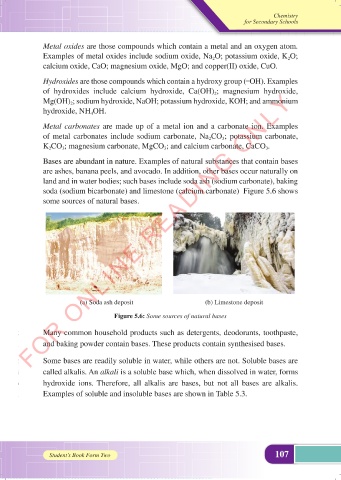
              Bases are abundant in nature. Examples of natural substances that contain bases
              are ashes, banana peels, and avocado. In addition, other bases occur naturally on
              land and in water bodies; such bases include soda ash (sodium carbonate), baking
              soda (sodium bicarbonate) and limestone (calcium carbonate)  Figure 5.6 shows
              some sources of natural bases.


                         (a) Soda ash deposit                  (b) Limestone deposit

                                    Figure 5.6: Some sources of natural bases

              Many common household products such as detergents, deodorants, toothpaste,
              and baking powder contain bases. These products contain synthesised bases.

              Some bases are readily soluble in water, while others are not. Soluble bases are
              called alkalis. An alkali is a soluble base which, when dissolved in water, forms
              hydroxide  ions. Therefore, all  alkalis  are  bases, but not all  bases are alkalis.
              Examples of soluble and insoluble bases are shown in Table 5.3.


                Student’s Book Form Two                                             107


                                                                                          01/08/2025   11:21:03
     CHEMISTRY FORM TWO NEW 2025 DUMMY.indd   107                                         01/08/2025   11:21:03
     CHEMISTRY FORM TWO NEW 2025 DUMMY.indd   107

