


Page 113 - Chemistry_Form_2
P. 113
Chemistry
              for Secondary Schools


              Note:
              (a)  The pH values of solutions increase with decrease in acidity; therefore, weak
                  acids have higher pH values than strong acids.
              (b) Solutions of strong acids are good conductors of electricity because they
          FOR ONLINE READING ONLY
                  contain more free mobile ions to carry the charges than solutions of weak
                  acids.


              Basicity of an acid

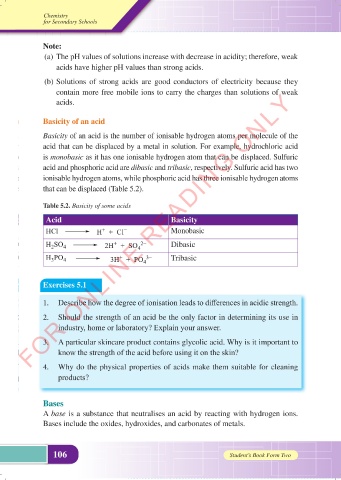
              Basicity of an acid is the number of ionisable hydrogen atoms per molecule of the
              acid that can be displaced by a metal in solution. For example, hydrochloric acid
              is monobasic as it has one ionisable hydrogen atom that can be displaced. Sulfuric
              acid and phosphoric acid are dibasic and tribasic, respectively. Sulfuric acid has two
              ionisable hydrogen atoms, while phosphoric acid has three ionisable hydrogen atoms
              that can be displaced (Table 5.2).

              Table 5.2. Basicity of some acids
               Acid                                  Basicity
                                                     Monobasic

                                                     Dibasic

                                                     Tribasic


              Exercises 5.1

              1.  Describe how the degree of ionisation leads to differences in acidic strength.

              2.  Should the strength of an acid be the only factor in determining its use in
                   industry, home or laboratory? Explain your answer.

              3.  A particular skincare product contains glycolic acid. Why is it important to
                   know the strength of the acid before using it on the skin?
              4.  Why do the physical properties of acids make them suitable for cleaning
                   products?


              Bases
              A base is a substance that neutralises an acid by reacting with hydrogen ions.
              Bases include the oxides, hydroxides, and carbonates of metals.


                 106                                                  Student’s Book Form Two


                                                                                          01/08/2025   11:21:03
     CHEMISTRY FORM TWO NEW 2025 DUMMY.indd   106                                         01/08/2025   11:21:03
     CHEMISTRY FORM TWO NEW 2025 DUMMY.indd   106

