


Page 110 - Chemistry_Form_2
P. 110
Chemistry
                                                                           for Secondary Schools


                                                   Thistle funnel
                Retort stand                       Acid


          FOR ONLINE READING ONLY
                                                             Derivery tube

                                                                           Test tube holder

                                              Boiling tube               Limewater

                                              Dilute acid            Bubbles of carbon dioxide
                                               Metal carbonate


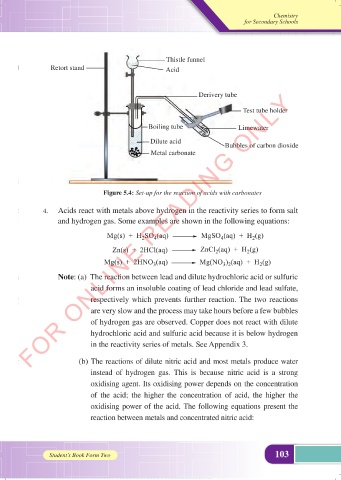
                                Figure 5.4: Set-up for the reaction of acids with carbonates

              4.   Acids react with metals above hydrogen in the reactivity series to form salt
                   and hydrogen gas. Some examples are shown in the following equations:


                   Note: (a)  The reaction between lead and dilute hydrochloric acid or sulfuric
                            acid forms an insoluble coating of lead chloride and lead sulfate,

                            respectively which prevents further reaction. The two reactions
                            are very slow and the process may take hours before a few bubbles
                            of hydrogen gas are observed. Copper does not react with dilute
                            hydrochloric acid and sulfuric acid because it is below hydrogen
                            in the reactivity series of metals. See Appendix 3.

                         (b) The reactions of dilute nitric acid and most metals produce water
                            instead of hydrogen  gas.  This is because nitric acid is a strong
                            oxidising agent. Its oxidising power depends on the concentration

                            of the acid; the higher the  concentration of acid, the higher the
                            oxidising power of the acid. The following equations present the
                            reaction between metals and concentrated nitric acid:


                Student’s Book Form Two                                             103


                                                                                          01/08/2025   11:21:01
     CHEMISTRY FORM TWO NEW 2025 DUMMY.indd   103                                         01/08/2025   11:21:01
     CHEMISTRY FORM TWO NEW 2025 DUMMY.indd   103

