


Page 107 - Chemistry_Form_2
P. 107
Chemistry
              for Secondary Schools


          FOR ONLINE READING ONLY


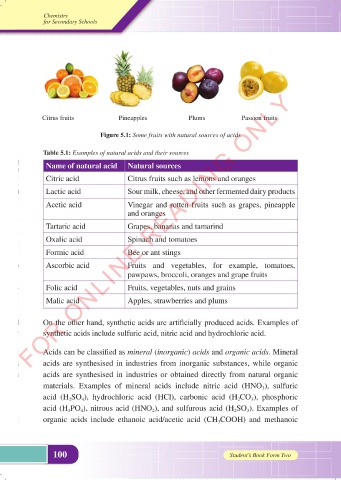
              Citrus fruits                           Pineapples                         Plums                      Passion fruits


                               Figure 5.1: Some fruits with natural sources of acids

              Table 5.1: Examples of natural acids and their sources
               Name of natural acid     Natural sources

               Citric acid              Citrus fruits such as lemons and oranges
               Lactic acid              Sour milk, cheese, and other fermented dairy products

               Acetic acid              Vinegar and rotten fruits such as grapes, pineapple
                                        and oranges

               Tartaric acid            Grapes, bananas and tamarind
               Oxalic acid              Spinach and tomatoes

               Formic acid              Bee or ant stings
               Ascorbic acid            Fruits and vegetables,  for example, tomatoes,
                                        pawpaws, broccoli, oranges and grape fruits
               Folic acid               Fruits, vegetables, nuts and grains

               Malic acid               Apples, strawberries and plums


              On the other hand, synthetic acids are artificially produced acids. Examples of
              synthetic acids include sulfuric acid, nitric acid and hydrochloric acid.

              Acids can be classified as mineral (inorganic) acids and organic acids. Mineral

              acids are synthesised in industries from inorganic substances, while organic
              acids are synthesised in industries or obtained directly from natural organic
              materials. Examples of mineral  acids include nitric acid (HNO 3 ), sulfuric
              acid (H 2 SO 4 ),  hydrochloric acid (HCl), carbonic acid (H 2 CO 3 ), phosphoric
              acid (H 3 PO 4 ), nitrous acid (HNO 2 ), and sulfurous acid (H 2 SO 3 ). Examples of
              organic  acids include ethanoic acid/acetic acid (CH 3 COOH) and  methanoic


                 100                                                  Student’s Book Form Two


                                                                                          01/08/2025   11:21:00
     CHEMISTRY FORM TWO NEW 2025 DUMMY.indd   100                                         01/08/2025   11:21:00
     CHEMISTRY FORM TWO NEW 2025 DUMMY.indd   100

