


Page 104 - Chemistry_Form_2
P. 104
Chemistry
                                                                           for Secondary Schools


                  (b)   The elements of the compound become the products.
                  (c)   The reactant is a single substance.
                  (d)   Can have either an ionic or a molecular compound as the reactant.

              4.  The following processes are applications of neutralisation reactions, except?
          FOR ONLINE READING ONLY
                   (a)   Rubbing baking powder on the bee sting.
                   (b)   Adding quicklime in the acidic soil.
                   (c)   Applying vaseline to the burn wound.
                   (d)   Brushing teeth with toothpaste.

              5.  Why is it important to understand chemical equations in cooking?
                   (a)   To balance the temperature of the ingredients.
                   (b)   Chemical reactions prevent food overcooking.
                   (c)   It helps measure cooking time accurately.
                   (d)  To understand how ingredients behave when heated.


              6.  Analyse the following types of chemical reactions by writing simple balanced
                   chemical equations and explaining at least three real-life applications:
                   (a)  Combination
                   (b)  Decomposition
                   (c)  Displacement
                   (d)  Precipitation
                   (e)  Redox
              7.  Write the word equation for each of the following reactions:
                    (a) Burning calcium in oxygen gas.

                    (b) Dissolving zinc in dilute sulfuric acid.
                    (c) Reacting sodium with water.

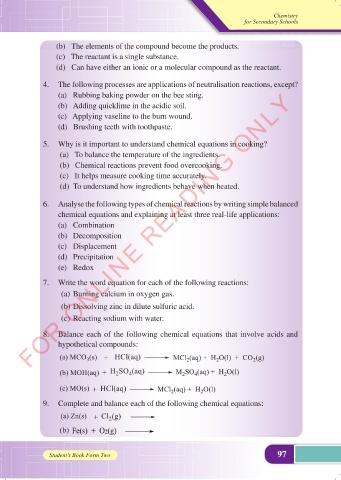
              8.  Balance each of the following chemical equations that involve acids and
                   hypothetical compounds:


              9.  Complete and balance each of the following chemical equations:


                Student’s Book Form Two                                              97


                                                                                          01/08/2025   11:21:00
     CHEMISTRY FORM TWO NEW 2025 DUMMY.indd   97                                          01/08/2025   11:21:00
     CHEMISTRY FORM TWO NEW 2025 DUMMY.indd   97

