


Page 101 - Chemistry_Form_2
P. 101
Chemistry
              for Secondary Schools


              life including photosynthesis, respiration, combustion, bleaching, digestion, and
              corrosion or rusting. In a redox reaction, oxidation and reduction reactions occur
              simultaneously.


              A chemical reaction is said to be an oxidation reaction when its reacting substance
          FOR ONLINE READING ONLY
              combines with oxygen, or hydrogen is removed from it. It can also be a loss of
              electrons from that substance, or increase in oxidation state of that substance.
              On the other hand, a chemical reaction is said to be a reduction reaction when its
              reacting substance combines with hydrogen, or when oxygen is removed from
              that substance. It can also be a gain of electron(s) leading to the decrease in the
              oxidation state of that substance.

              Oxidation and reduction reactions are opposite types of reactions. During a redox
              reaction, if one substance is oxidised by either gaining oxygen, losing hydrogen
              or losing one or more electrons, another substance must at the same time be
              reduced by losing oxygen, gaining hydrogen or gaining one or more electrons. For
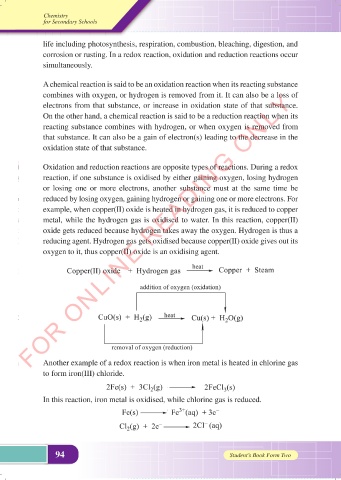
              example, when copper(II) oxide is heated in hydrogen gas, it is reduced to copper
              metal, while the hydrogen gas is oxidised to water. In this reaction, copper(II)
              oxide gets reduced because hydrogen takes away the oxygen. Hydrogen is thus a
              reducing agent. Hydrogen gas gets oxidised because copper(II) oxide gives out its
              oxygen to it, thus copper(II) oxide is an oxidising agent.


              Another example of a redox reaction is when iron metal is heated in chlorine gas
              to form iron(III) chloride.


              In this reaction, iron metal is oxidised, while chlorine gas is reduced.


                  94                                                  Student’s Book Form Two


                                                                                          01/08/2025   11:20:59
     CHEMISTRY FORM TWO NEW 2025 DUMMY.indd   94
     CHEMISTRY FORM TWO NEW 2025 DUMMY.indd   94                                          01/08/2025   11:20:59

