


Page 100 - Chemistry_Form_2
P. 100
Chemistry
                                                                           for Secondary Schools


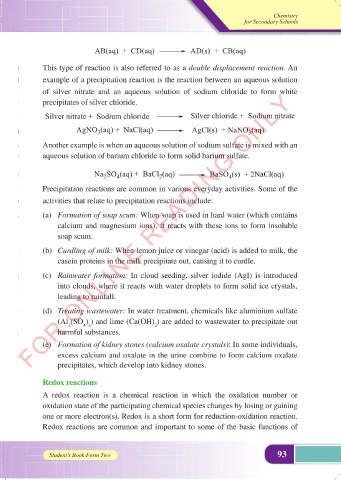
              This type of reaction is also referred to as a double displacement reaction. An
              example of a precipitation reaction is the reaction between an aqueous solution
          FOR ONLINE READING ONLY
              of  silver nitrate and an aqueous  solution of sodium chloride to form white
              precipitates of silver chloride.


              Another example is when an aqueous solution of sodium sulfate is mixed with an
              aqueous solution of barium chloride to form solid barium sulfate.


              Precipitation reactions are common in various everyday activities. Some of the
              activities that relate to precipitation reactions include:

              (a)  Formation of soap scum: When soap is used in hard water (which contains
                  calcium and magnesium ions), it reacts with these ions to form insoluble
                  soap scum.
              (b)  Curdling of milk: When lemon juice or vinegar (acid) is added to milk, the
                  casein proteins in the milk precipitate out, causing it to curdle.

              (c)  Rainwater formation: In cloud seeding, silver iodide (AgI) is introduced
                  into clouds, where it reacts with water droplets to form solid ice crystals,
                  leading to rainfall.

              (d)  Treating wastewater: In water treatment, chemicals like aluminium sulfate
                  (Al (SO ) ) and lime (Ca(OH) ) are added to wastewater to precipitate out
                                                2
                          4 3
                      2
                  harmful substances.
              (e)  Formation of kidney stones (calcium oxalate crystals): In some individuals,
                  excess calcium and oxalate in the urine combine to form calcium oxalate
                  precipitates, which develop into kidney stones.

              Redox reactions

              A redox reaction  is a chemical  reaction  in which the  oxidation  number  or
              oxidation state of the participating chemical species changes by losing or gaining
              one or more electron(s). Redox is a short form for reduction-oxidation reaction.
              Redox reactions are common and important to some of the basic functions of


                Student’s Book Form Two                                              93


                                                                                          01/08/2025   11:20:59
     CHEMISTRY FORM TWO NEW 2025 DUMMY.indd   93                                          01/08/2025   11:20:59
     CHEMISTRY FORM TWO NEW 2025 DUMMY.indd   93

