


Page 99 - Chemistry_Form_2
P. 99
Chemistry
              for Secondary Schools


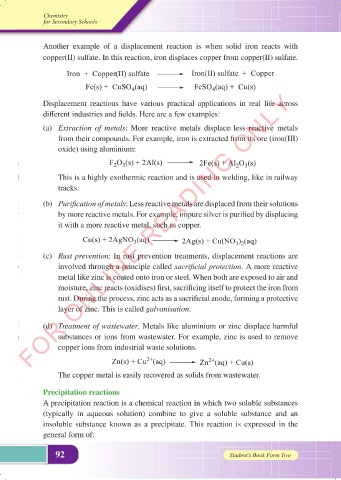
              Another example  of a  displacement  reaction  is when  solid  iron reacts  with
              copper(II) sulfate. In this reaction, iron displaces copper from copper(II) sulfate.


          FOR ONLINE READING ONLY
              Displacement  reactions  have  various practical  applications  in real  life  across
              different industries and fields. Here are a few examples:

              (a)  Extraction  of metals: More reactive  metals  displace  less  reactive  metals
                   from their compounds. For example, iron is extracted from its ore (iron(III)
                   oxide) using aluminium:


                   This is a highly exothermic reaction and is used in welding, like in railway
                   tracks.

              (b)  Purification of metals: Less reactive metals are displaced from their solutions
                   by more reactive metals. For example, impure silver is purified by displacing
                   it with a more reactive metal, such as copper.


              (c)  Rust prevention: In rust prevention treatments, displacement reactions are
                   involved through a principle called sacrificial protection. A more reactive
                   metal like zinc is coated onto iron or steel. When both are exposed to air and
                   moisture, zinc reacts (oxidises) first, sacrificing itself to protect the iron from
                   rust. During the process, zinc acts as a sacrificial anode, forming a protective
                   layer of zinc. This is called galvanisation.

              (d)  Treatment of wastewater. Metals like aluminium or zinc displace harmful
                   substances or ions from wastewater. For example, zinc is used to remove
                   copper ions from industrial waste solutions.


                   The copper metal is easily recovered as solids from wastewater.

              Precipitation reactions
              A precipitation reaction is a chemical reaction in which two soluble substances
              (typically  in  aqueous  solution)  combine  to  give  a  soluble  substance  and  an
              insoluble  substance known as a precipitate. This reaction is expressed  in the
              general form of:


                  92                                                  Student’s Book Form Two


                                                                                          01/08/2025   11:20:59
     CHEMISTRY FORM TWO NEW 2025 DUMMY.indd   92
     CHEMISTRY FORM TWO NEW 2025 DUMMY.indd   92                                          01/08/2025   11:20:59

