


Page 98 - Chemistry_Form_2
P. 98
Chemistry
                                                                           for Secondary Schools


              Combustion reactions are essential for energy production, heating, and
              transportation, making them indispensable in everyday life.  These reactions
              release energy by burning fuels or materials, driving many practical applications.
              Some processes related to combustion reactions include:
          FOR ONLINE READING ONLY
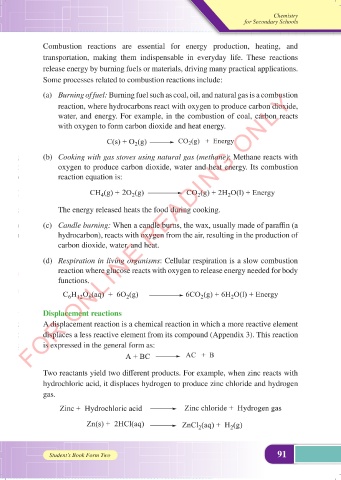
              (a)  Burning of fuel: Burning fuel such as coal, oil, and natural gas is a combustion
                   reaction, where hydrocarbons react with oxygen to produce carbon dioxide,
                   water, and energy. For example, in the combustion of coal, carbon reacts
                   with oxygen to form carbon dioxide and heat energy.


              (b)  Cooking with gas stoves using natural gas (methane): Methane reacts with
                   oxygen to produce carbon dioxide, water and heat energy. Its combustion
                   reaction equation is:


                   The energy released heats the food during cooking.


              (c)  Candle burning: When a candle burns, the wax, usually made of paraffin (a
                   hydrocarbon), reacts with oxygen from the air, resulting in the production of
                   carbon dioxide, water, and heat.

              (d)  Respiration in living organisms: Cellular respiration is a slow combustion
                   reaction where glucose reacts with oxygen to release energy needed for body
                   functions.


              Displacement reactions
              A displacement reaction is a chemical reaction in which a more reactive element
              displaces a less reactive element from its compound (Appendix 3). This reaction
              is expressed in the general form as:


              Two reactants yield two different products. For example, when zinc reacts with
              hydrochloric acid, it displaces hydrogen to produce zinc chloride and hydrogen
              gas.


                Student’s Book Form Two                                              91


                                                                                          01/08/2025   11:20:59
     CHEMISTRY FORM TWO NEW 2025 DUMMY.indd   91                                          01/08/2025   11:20:59
     CHEMISTRY FORM TWO NEW 2025 DUMMY.indd   91

