


Page 96 - Chemistry_Form_2
P. 96
Chemistry
                                                                           for Secondary Schools


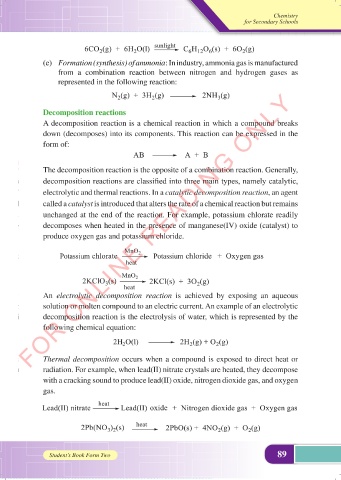
              (e)  Formation (synthesis) of ammonia: In industry, ammonia gas is manufactured
                   from a  combination  reaction  between  nitrogen  and  hydrogen  gases as
                   represented in the following reaction:
          FOR ONLINE READING ONLY


              Decomposition reactions
              A decomposition reaction is a chemical reaction in which a compound breaks
              down (decomposes) into its components. This reaction can be expressed in the
              form of:


              The decomposition reaction is the opposite of a combination reaction. Generally,
              decomposition reactions are classified into three main types, namely catalytic,
              electrolytic and thermal reactions. In a catalytic decomposition reaction, an agent
              called a catalyst is introduced that alters the rate of a chemical reaction but remains

              unchanged at the end of the reaction. For example, potassium chlorate readily
              decomposes when heated in the presence of manganese(IV) oxide (catalyst) to
              produce oxygen gas and potassium chloride.


              An  electrolytic  decomposition  reaction is achieved  by exposing an aqueous
              solution or molten compound to an electric current. An example of an electrolytic
              decomposition reaction is the electrolysis of water, which is represented by the
              following chemical equation:


              Thermal decomposition occurs when a compound is exposed to direct heat or
              radiation. For example, when lead(II) nitrate crystals are heated, they decompose
              with a cracking sound to produce lead(II) oxide, nitrogen dioxide gas, and oxygen
              gas.


                Student’s Book Form Two                                              89


                                                                                          01/08/2025   11:20:59
     CHEMISTRY FORM TWO NEW 2025 DUMMY.indd   89
     CHEMISTRY FORM TWO NEW 2025 DUMMY.indd   89                                          01/08/2025   11:20:59

