


Page 108 - Chemistry_Form_2
P. 108
Chemistry
                                                                           for Secondary Schools


              acid (HCOOH).  The most
              common acids that are found
              in  a  chemistry  laboratory
              include hydrochloric acid,
          FOR ONLINE READING ONLY
              sulfuric acid,  nitric acid,
              and acetic  acid.  Common
              acids  in  the  laboratory
              are  stored  in  various
              containers  such as  plastic
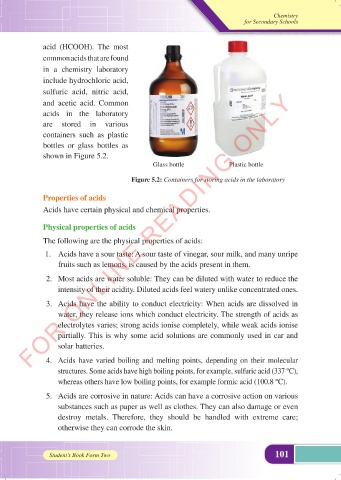
              bottles or  glass bottles as
              shown in Figure 5.2.
                                               Glass bottle                           Plastic bottle

                                         Figure 5.2: Containers for storing acids in the laboratory

              Properties of acids
              Acids have certain physical and chemical properties.


              Physical properties of acids
              The following are the physical properties of acids:

               1.  Acids have a sour taste: A sour taste of vinegar, sour milk, and many unripe
                   fruits such as lemons, is caused by the acids present in them.

               2.  Most acids are water soluble: They can be diluted with water to reduce the
                   intensity of their acidity. Diluted acids feel watery unlike concentrated ones.
               3.  Acids have the ability to conduct electricity: When acids are dissolved in
                   water, they release ions which conduct electricity. The strength of acids as
                   electrolytes varies; strong acids ionise completely, while weak acids ionise
                   partially. This is why some acid solutions are commonly used in car and
                   solar batteries.

               4.  Acids have varied boiling and melting points, depending on their molecular
                   structures. Some acids have high boiling points, for example, sulfuric acid (337 °C),
                   whereas others have low boiling points, for example formic acid (100.8 °C).

               5.  Acids are corrosive in nature: Acids can have a corrosive action on various
                   substances such as paper as well as clothes. They can also damage or even
                   destroy metals.  Therefore, they should be handled with extreme  care;
                   otherwise they can corrode the skin.


                Student’s Book Form Two                                             101


                                                                                          01/08/2025   11:21:00
     CHEMISTRY FORM TWO NEW 2025 DUMMY.indd   101                                         01/08/2025   11:21:00
     CHEMISTRY FORM TWO NEW 2025 DUMMY.indd   101

