


Page 112 - Chemistry_Form_2
P. 112
Chemistry
                                                                           for Secondary Schools


              Questions
              1.  What are the balanced chemical equations for the reaction between:

                  (a) zinc and dilute hydrochloric acid?
                  (b) zinc and dilute sulfuric acid?
          FOR ONLINE READING ONLY
                  (c) magnesium and dilute hydrochloric acid?
                  (d) magnesium and dilute sulfuric acid?

              2.  What causes the observations recorded in Step 3 of the experiments? Support
                  with balanced chemical equations.

              3.  What happened in Steps 2 and 3 when lead and copper were used in the
                  experiment? Write the balanced chemical equations for the reactions of these
                  metals with sulfuric acid.


                  Task 5.2

              Use  virtual  laboratories  or  interactive  simulations  and  animations  to  explore  the
              strength and the basicity of acids.


              Strengths of acids
              The strength of an acid is a measure of its ability to ionise (dissociate) in water
              to produce hydrogen ions (H ). The more the acid ionises in water, the stronger it
                                         +
              is. The strength of the acid solution can be determined by its pH value. The pH is
              the measure of the degree of acidity or alkalinity of the solution. Based on their
              strengths, acids are grouped into strong acids and weak acids.

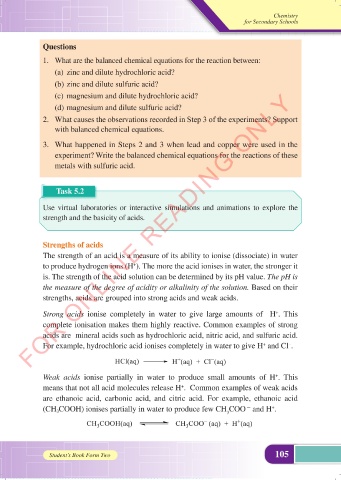
              Strong  acids ionise  completely  in  water  to  give  large  amounts  of  H .  This
                                                                                    +
              complete ionisation makes them highly reactive. Common examples of strong
              acids are  mineral acids such as hydrochloric acid, nitric acid, and sulfuric acid.
              For example, hydrochloric acid ionises completely in water to give H  and Cl .
                                                                                        −
                                                                                 +


              Weak  acids ionise  partially in  water  to  produce  small  amounts of H . This
                                                                                    +
              means that not all acid molecules release H .  Common examples of weak acids
                                                        +
              are ethanoic  acid,  carbonic acid,  and citric  acid.  For example,  ethanoic  acid
              (CH COOH) ionises partially in water to produce few CH COO and H .
                                                                                   +
                                                                            ─
                  3
                                                                      3


                Student’s Book Form Two                                             105


                                                                                          01/08/2025   11:21:02
     CHEMISTRY FORM TWO NEW 2025 DUMMY.indd   105                                         01/08/2025   11:21:02
     CHEMISTRY FORM TWO NEW 2025 DUMMY.indd   105

