


Page 115 - Chemistry_Form_2
P. 115
Chemistry
              for Secondary Schools


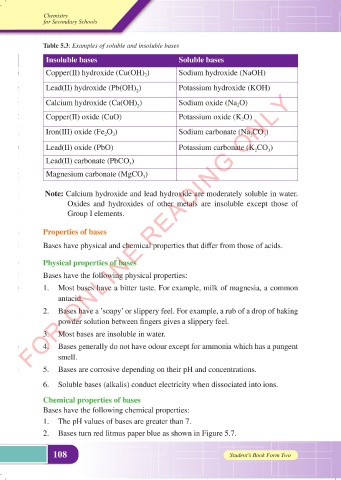
              Table 5.3: Examples of soluble and insoluble bases
               Insoluble bases                         Soluble bases

               Copper(II) hydroxide (Cu(OH) 2 )        Sodium hydroxide (NaOH)

               Lead(II) hydroxide (Pb(OH) )            Potassium hydroxide (KOH)
          FOR ONLINE READING ONLY
                                          2
               Calcium hydroxide (Ca(OH) )             Sodium oxide (Na 2 O)
                                          2
               Copper(II) oxide (CuO)                  Potassium oxide (K 2 O)

               Iron(III) oxide (Fe 2 O 3 )             Sodium carbonate (Na CO )
                                                                             2
                                                                                 3
               Lead(II) oxide (PbO)                    Potassium carbonate (K CO )
                                                                                  3
                                                                              2
               Lead(II) carbonate (PbCO )
                                        3
               Magnesium carbonate (MgCO )
                                            3

               Note: Calcium hydroxide and lead hydroxide are moderately soluble in water.
                     Oxides and  hydroxides  of other  metals  are  insoluble  except  those of
                     Group I elements.


              Properties of bases
              Bases have physical and chemical properties that differ from those of acids.


              Physical properties of bases
              Bases have the following physical properties:
              1.  Most bases have a bitter taste. For example, milk of magnesia, a common
                   antacid.

              2.  Bases have a ’soapy’ or slippery feel. For example, a rub of a drop of baking
                   powder solution between fingers gives a slippery feel.
              3.  Most bases are insoluble in water.
              4.  Bases generally do not have odour except for ammonia which has a pungent
                   smell.

              5.  Bases are corrosive depending on their pH and concentrations.

              6.  Soluble bases (alkalis) conduct electricity when dissociated into ions.
              Chemical properties of bases
              Bases have the following chemical properties:
              1.  The pH values of bases are greater than 7.

              2.  Bases turn red litmus paper blue as shown in Figure 5.7.


                 108                                                  Student’s Book Form Two


                                                                                          01/08/2025   11:21:03
     CHEMISTRY FORM TWO NEW 2025 DUMMY.indd   108                                         01/08/2025   11:21:03
     CHEMISTRY FORM TWO NEW 2025 DUMMY.indd   108

