


Page 116 - Chemistry_Form_2
P. 116
Chemistry
                                                                           for Secondary Schools


          FOR ONLINE READING ONLY


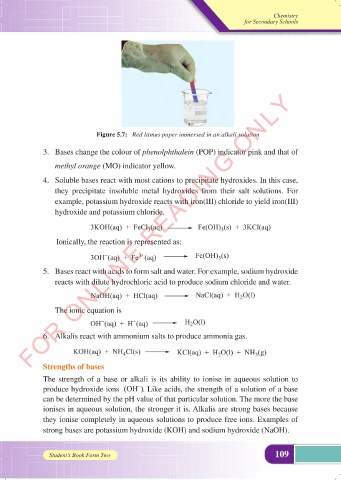
                              Figure 5.7:   Red litmus paper immersed in an alkali solution


              3.  Bases change the colour of phenolphthalein (POP) indicator pink and that of
                  methyl orange (MO) indicator yellow.

              4.  Soluble bases react with most cations to precipitate hydroxides. In this case,
                  they  precipitate  insoluble  metal  hydroxides from their  salt  solutions. For
                  example, potassium hydroxide reacts with iron(III) chloride to yield iron(III)
                  hydroxide and potassium chloride.


                  Ionically, the reaction is represented as:


              5.  Bases react with acids to form salt and water. For example, sodium hydroxide
                  reacts with dilute hydrochloric acid to produce sodium chloride and water.


                  The ionic equation is


              6.  Alkalis react with ammonium salts to produce ammonia gas.


              Strengths of bases
              The strength of a base or alkali is its ability to ionise in aqueous solution to
              produce hydroxide ions        . Like acids, the strength of a solution of a base
              can be determined by the pH value of that particular solution. The more the base
              ionises in aqueous solution, the stronger it is. Alkalis are strong bases because
              they ionise completely in aqueous solutions to produce free ions. Examples of
              strong bases are potassium hydroxide (KOH) and sodium hydroxide (NaOH).


                Student’s Book Form Two                                             109


                                                                                          01/08/2025   11:21:03
     CHEMISTRY FORM TWO NEW 2025 DUMMY.indd   109                                         01/08/2025   11:21:03
     CHEMISTRY FORM TWO NEW 2025 DUMMY.indd   109

