


Page 144 - Chemistry_Form_2
P. 144
Chemistry
                                                                           for Secondary Schools


                        Activity 5.14


              Aim: To investigate the action of heat on sodium sulfate and iron(II) sulfate

              Requirements:  Ignition tube, spatula,  heat source, sodium sulfate,  iron(II)
          FOR ONLINE READING ONLY
                               sulfate, and red and blue litmus papers
              Procedure

                1.  Put a spatulaful of sodium sulfate in the ignition tube and heat strongly.
                2.  Insert the wet blue and red litmus papers in the ignition tube while heating.
                   Record the observations.

                3.  Repeat Steps 1 and 2 by using iron(II) sulfate in the place of sodium sulfate.
                   Record the observations.


              Questions
              1. What were the colour changes in the two litmus papers?

              2. What do the colour changes in the litmus papers imply?


              Action of heat on chloride salts
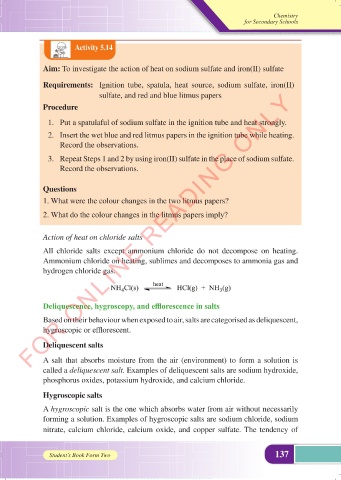
              All chloride  salts except ammonium  chloride do not decompose on  heating.
              Ammonium chloride on heating, sublimes and decomposes to ammonia gas and
              hydrogen chloride gas.


              Deliquescence, hygroscopy, and efflorescence in salts
              Based on their behaviour when exposed to air, salts are categorised as deliquescent,
              hygroscopic or efflorescent.

              Deliquescent salts

              A salt that absorbs moisture from the air (environment) to form a solution is
              called a deliquescent salt. Examples of deliquescent salts are sodium hydroxide,
              phosphorus oxides, potassium hydroxide, and calcium chloride.

              Hygroscopic salts
              A hygroscopic salt is the one which absorbs water from air without necessarily
              forming a solution. Examples of hygroscopic salts are sodium chloride, sodium
              nitrate, calcium chloride, calcium oxide, and copper sulfate. The tendency of


                Student’s Book Form Two                                             137


                                                                                          01/08/2025   11:21:11
     CHEMISTRY FORM TWO NEW 2025 DUMMY.indd   137                                         01/08/2025   11:21:11
     CHEMISTRY FORM TWO NEW 2025 DUMMY.indd   137

