


Page 139 - Chemistry_Form_2
P. 139
Chemistry
              for Secondary Schools


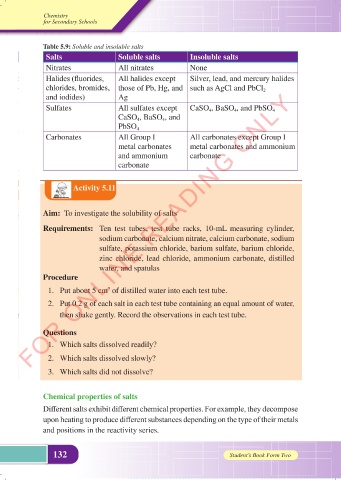
              Table 5.9: Soluble and insoluble salts
               Salts                 Soluble salts        Insoluble salts
               Nitrates              All nitrates         None
               Halides (fluorides,   All halides except   Silver, lead, and mercury halides
          FOR ONLINE READING ONLY
               chlorides, bromides,  those of Pb, Hg, and  such as AgCl and PbCl 2
               and iodides)          Ag
               Sulfates              All sulfates except   CaSO 4 , BaSO 4 , and PbSO 4
                                     CaSO 4 , BaSO 4 , and
                                     PbSO 4
               Carbonates            All Group I          All carbonates except Group I
                                     metal carbonates     metal carbonates and ammonium
                                     and ammonium         carbonate
                                     carbonate


                       Activity 5.11


              Aim:  To investigate the solubility of salts

              Requirements:   Ten test  tubes, test  tube  racks, 10-mL measuring  cylinder,
                               sodium carbonate, calcium nitrate, calcium carbonate, sodium
                               sulfate, potassium chloride, barium sulfate, barium chloride,
                               zinc chloride, lead chloride, ammonium carbonate, distilled
                               water, and spatulas
              Procedure

                1.   Put about 5 cm  of distilled water into each test tube.
                                  3
                2.   Put 0.2 g of each salt in each test tube containing an equal amount of water,
                   then shake gently. Record the observations in each test tube.


              Questions
                1.  Which salts dissolved readily?

                2.  Which salts dissolved slowly?
                3.  Which salts did not dissolve?


              Chemical properties of salts
              Different salts exhibit different chemical properties. For example, they decompose
              upon heating to produce different substances depending on the type of their metals
              and positions in the reactivity series.


                 132                                                  Student’s Book Form Two


                                                                                          01/08/2025   11:21:10
     CHEMISTRY FORM TWO NEW 2025 DUMMY.indd   132                                         01/08/2025   11:21:10
     CHEMISTRY FORM TWO NEW 2025 DUMMY.indd   132

