


Page 141 - Chemistry_Form_2
P. 141
Chemistry
              for Secondary Schools


              vapour.  A red litmus paper turns blue due to the basic condition of ammonia
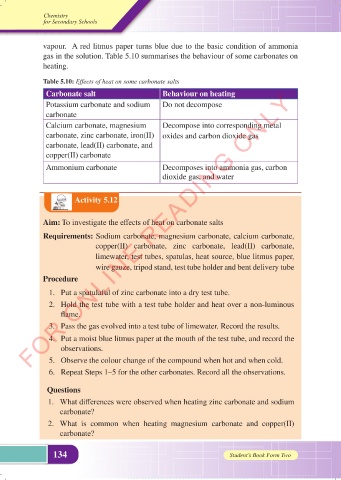
              gas in the solution. Table 5.10 summarises the behaviour of some carbonates on
              heating.

              Table 5.10: Effects of heat on some carbonate salts
          FOR ONLINE READING ONLY
               Carbonate salt                     Behaviour on heating
               Potassium carbonate and sodium     Do not decompose
               carbonate

               Calcium carbonate, magnesium       Decompose into corresponding metal
               carbonate, zinc carbonate, iron(II)  oxides and carbon dioxide gas
               carbonate, lead(II) carbonate, and
               copper(II) carbonate
               Ammonium carbonate                 Decomposes into ammonia gas, carbon
                                                  dioxide gas, and water


                        Activity 5.12


              Aim: To investigate the effects of heat on carbonate salts

              Requirements: Sodium carbonate, magnesium carbonate, calcium carbonate,
                              copper(II) carbonate,  zinc  carbonate, lead(II)  carbonate,
                              limewater, test tubes, spatulas, heat source, blue litmus paper,
                              wire gauze, tripod stand, test tube holder and bent delivery tube

              Procedure
                1.  Put a spatulaful of zinc carbonate into a dry test tube.
                2.  Hold the test tube with a test tube holder and heat over a non-luminous
                   flame.
                3.  Pass the gas evolved into a test tube of limewater. Record the results.

                4.  Put a moist blue litmus paper at the mouth of the test tube, and record the
                   observations.
                5.  Observe the colour change of the compound when hot and when cold.
                6.  Repeat Steps 1–5 for the other carbonates. Record all the observations.


                Questions
                1.  What differences were observed when heating zinc carbonate and sodium
                   carbonate?
                2.  What  is common  when heating  magnesium  carbonate  and  copper(II)
                   carbonate?


                 134                                                  Student’s Book Form Two


                                                                                          01/08/2025   11:21:10
     CHEMISTRY FORM TWO NEW 2025 DUMMY.indd   134                                         01/08/2025   11:21:10
     CHEMISTRY FORM TWO NEW 2025 DUMMY.indd   134

