


Page 138 - Chemistry_Form_2
P. 138
Chemistry
                                                                           for Secondary Schools


              Physical properties of salts

              The physical properties of salts include their appearance in colour, texture, and
              solubility.

          FOR ONLINE READING ONLY
              Physical appearance of salts
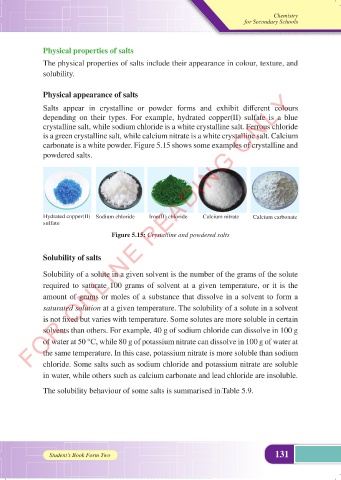
              Salts  appear  in  crystalline  or  powder  forms  and  exhibit  different  colours
              depending  on  their  types.  For example,  hydrated  copper(II)  sulfate  is  a  blue
              crystalline salt, while sodium chloride is a white crystalline salt. Ferrous chloride
              is a green crystalline salt, while calcium nitrate is a white crystalline salt. Calcium
              carbonate is a white powder. Figure 5.15 shows some examples of crystalline and
              powdered salts.


              Hydrated copper(II)  Sodium chloride  Iron(II) chloride  Calcium nitrate  Calcium carbonate
              sulfate

                                   Figure 5.15: Crystalline and powdered salts


              Solubility of salts

              Solubility of a solute in a given solvent is the number of the grams of the solute
              required to saturate 100 grams of solvent at a given temperature, or it is the
              amount of grams or moles of a substance that dissolve in a solvent to form a
              saturated solution at a given temperature. The solubility of a solute in a solvent
              is not fixed but varies with temperature. Some solutes are more soluble in certain
              solvents than others. For example, 40 g of sodium chloride can dissolve in 100 g

              of water at 50 °C, while 80 g of potassium nitrate can dissolve in 100 g of water at
              the same temperature. In this case, potassium nitrate is more soluble than sodium
              chloride. Some salts such as sodium chloride and potassium nitrate are soluble
              in water, while others such as calcium carbonate and lead chloride are insoluble.

              The solubility behaviour of some salts is summarised in Table 5.9.


                Student’s Book Form Two                                             131


                                                                                          01/08/2025   11:21:09
     CHEMISTRY FORM TWO NEW 2025 DUMMY.indd   131                                         01/08/2025   11:21:09
     CHEMISTRY FORM TWO NEW 2025 DUMMY.indd   131

