


Page 137 - Chemistry_Form_2
P. 137
Chemistry
              for Secondary Schools


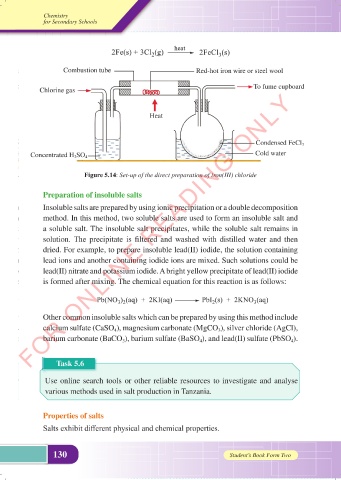
                    Combustion tube                         Red-hot iron wire or steel wool

                                                                              To fume cupboard
             Chlorine gas
          FOR ONLINE READING ONLY


                                              Heat


                                                                              Condensed FeCl 3
                                                                              Cold water
          Concentrated H 2SO 4

                           Figure 5.14: Set-up of the direct preparation of iron(III) chloride


              Preparation of insoluble salts
              Insoluble salts are prepared by using ionic precipitation or a double decomposition
              method. In this method, two soluble salts are used to form an insoluble salt and
              a soluble salt. The insoluble salt precipitates, while the soluble salt remains in
              solution. The  precipitate  is  filtered  and  washed  with  distilled  water and then
              dried. For example, to prepare insoluble lead(II) iodide, the solution containing
              lead ions and another containing iodide ions are mixed. Such solutions could be
              lead(II) nitrate and potassium iodide. A bright yellow precipitate of lead(II) iodide
              is formed after mixing. The chemical equation for this reaction is as follows:


              Other common insoluble salts which can be prepared by using this method include
              calcium sulfate (CaSO 4 ), magnesium carbonate (MgCO 3 ), silver chloride (AgCl),
              barium carbonate (BaCO 3 ), barium sulfate (BaSO 4 ), and lead(II) sulfate (PbSO 4 ).


                  Task 5.6

               Use online search tools or other reliable resources to investigate and analyse
               various methods used in salt production in Tanzania.


              Properties of salts
              Salts exhibit different physical and chemical properties.


                 130                                                  Student’s Book Form Two


                                                                                          01/08/2025   11:21:09
     CHEMISTRY FORM TWO NEW 2025 DUMMY.indd   130                                         01/08/2025   11:21:09
     CHEMISTRY FORM TWO NEW 2025 DUMMY.indd   130

