


Page 135 - Chemistry_Form_2
P. 135
Chemistry
              for Secondary Schools


              Reactions of acids with insoluble bases

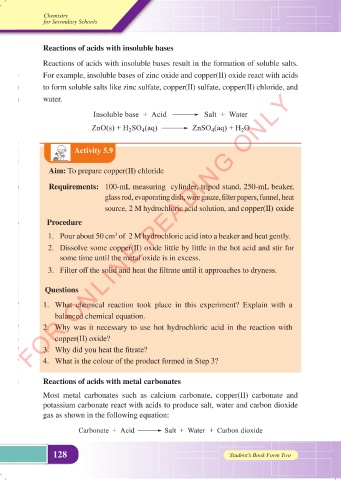
              Reactions of acids with insoluble bases result in the formation of soluble salts.
              For example, insoluble bases of zinc oxide and copper(II) oxide react with acids
              to form soluble salts like zinc sulfate, copper(II) sulfate, copper(II) chloride, and
          FOR ONLINE READING ONLY
              water.


                       Activity 5.9


                Aim: To prepare copper(II) chloride

                Requirements:   100-mL measuring  cylinder, tripod stand, 250-mL beaker,
                                 glass rod, evaporating dish, wire gauze, filter papers, funnel, heat
                                 source, 2 M hydrochloric acid solution, and copper(II) oxide,

                Procedure

                1.  Pour about 50 cm  of  2 M hydrochloric acid into a beaker and heat gently.
                                    3
                2.  Dissolve some copper(II) oxide little by little in the hot acid and stir for
                   some time until the metal oxide is in excess.
                3.  Filter off the solid and heat the filtrate until it approaches to dryness.


               Questions
              1.  What  chemical  reaction  took place  in this  experiment?  Explain  with  a

                  balanced chemical equation.
              2.  Why was it necessary to use hot  hydrochloric acid in the  reaction  with
                  copper(II) oxide?
              3.  Why did you heat the fitrate?
              4.  What is the colour of the product formed in Step 3?


              Reactions of acids with metal carbonates

              Most  metal  carbonates such as  calcium  carbonate,  copper(II) carbonate  and
              potassium carbonate react with acids to produce salt, water and carbon dioxide
              gas as shown in the following equation:


                 128                                                  Student’s Book Form Two


                                                                                          01/08/2025   11:21:08
     CHEMISTRY FORM TWO NEW 2025 DUMMY.indd   128                                         01/08/2025   11:21:08
     CHEMISTRY FORM TWO NEW 2025 DUMMY.indd   128

