


Page 105 - Mathematics_Form_Two
P. 105
Exponents and radicals
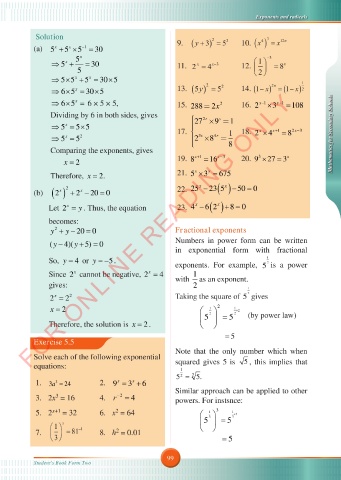
Solution 2 2 4 3 12n
x
(a) 5 + x 5 × x 5 = − 1 30. 9. ( y + ) 3 5 = 10. ( ) = x
5 x 1 - 3
⇒ 5 + x = 30. 11. 2 x 4 = x - 3 12. æö = 8 x
5 ç÷
2
èø
x
5 5 +
⇒× x 5 = 30 5.× 1
2
5
FOR ONLINE READING ONLY
⇒× x 30 5.× 13. ( ) = 5y 2 14. (1 ) x 2n = (1- - 2 ) x
6 5 =
6 5 = 6 × 5 × 5,
⇒× x 30 5.× 15. 288= 2x 2 16. 2 x− 1 × 3 y+ 1 = 108
Dividing by 6 in both sides, gives ⎧ 2r s
⎪
⎪
⇒ 5 = x 5 5.× 17. ⎨ 27 ×9 =1 18. 2 × x 4 x+ 1 8 2x− 3
⎪
4r
3s
⇒ 5 = x 5. ⎪ 2 ×8 = 1 = Mathematics for Secondary Schools
2
⎪
⎪
Comparing the exponents, gives ⎩ 8
x = 2. 19. 8 x+ 1 = 16 x− 3 20. 9 × 3 27 3= x
2.
Therefore, x = . 21. 5 × x 3 = y 675
( ) 50 0−
2 22. 25 − x 23 5 x =
(b) ( ) + x 2 − x 20 0=
2
( ) 8 0+=
x
y
Let 2 = . Thus, the equation 23. 4 − 62 x
x
becomes:
2
y
y +− 20 0= Fractional exponents
(y − 4)(y + 5) 0= Numbers in power form can be written
in exponential form with fractional
So, y = or y = − . exponents. For example, 5 is a power
5
4
1
2
x
Since 2 cannot be negative, 2 = with 1 as an exponent.
4
x
gives: 2 1
2
2 = 2 2 Taking the square of 5 gives
x
x = 2 1 2 2 1 2 × 2
5 = 5 (by power law)
Therefore, the solution is x = .
2
5=
Exercise 5�5
Note that the only number which when
Solve each of the following exponential squared gives 5 is 5 , this implies that
equations: 1
5 = 2 5.
2
1. 3a = 24 2. 9 = 3 + 6
x
x
3
Similar approach can be applied to other
3
3. 2x = 16 4. r - 2 = 4 powers. For instsnce:
2
5. 2 x+1 = 32 6. x = 64 5 3 1 3 5 1 3 × 3
1 æö x =
2
7. ç÷ = 81 1 - 8. h = 0.01
3 èø 5=
99
Student's Book Form Two
11/10/2024 20:12:22
MATHEMATIC F2 v5.indd 99 11/10/2024 20:12:22
MATHEMATIC F2 v5.indd 99

