


Page 206 - Computer_Science_F5
P. 206
to global Internet access. As we move  (b) Goals of network security
              towards an information society, network   Network security aims to protect not
              security becomes more important,  only the computers at both ends of
              especially with the rise in cybercrime  communication but also the entire            Chapter Three: Advanced Computer Networks
              and legal challenges.                    network. Whether an organisation is small
          FOR ONLINE READING ONLY
                                                       or large, prioritising network security is
              (a) Meaning of network security          essential when using the Internet, LAN,

              Network security protects networks and  or other connectivity methods. The goals
              their services from unauthorized access,  of network security include maintaining:
              modification, destruction, or disclosure.   (i)  Confidentiality: Protecting data,
              It ensures that networks perform  their       objects, and resources from
              critical  functions  correctly  without       unauthorised access or viewing.
              harmful  side effects. Network privacy,   (ii)  Integrity: Ensuring the accuracy
              a part of network security, focuses on        and consistency of data, preserving
              protecting  user, application,  device,       its reliability and preventing
              and network data from unauthorized            unauthorized alterations.
              access. Most security issues are caused   (iii) Availability: Ensuring that data,
              by malicious individuals trying to gain       network resources, or services are
              something, get recognition, or harm           consistently accessible to legitimate
              others.                                       users whenever needed.


              (c) Network security measures
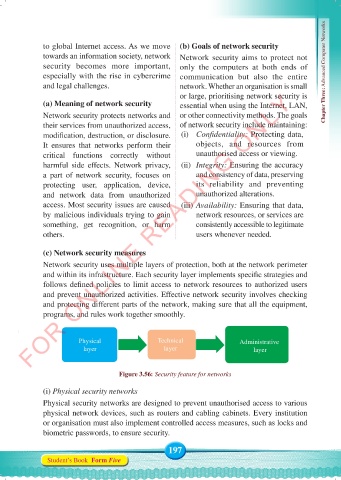
              Network security uses multiple layers of protection, both at the network perimeter
              and within its infrastructure. Each security layer implements specific strategies and
              follows defined policies to limit access to network resources to authorized users
              and prevent unauthorized activities. Effective network security involves checking
              and protecting different parts of the network, making sure that all the equipment,
              programs, and rules work together smoothly.


                         Physical                Technical               Administrative
                          layer                    layer                      layer


                                     Figure 3.56: Security feature for networks

              (i) Physical security networks
              Physical security networks are designed to prevent unauthorised access to various
              physical network devices, such as routers and cabling cabinets. Every institution
              or organisation must also implement controlled access measures, such as locks and
              biometric passwords, to ensure security.

                                                    197
               Student’s Book  Form Five


     Computer Science Form 5.indd   197                                                     23/07/2024   12:33

