


Page 158 - Theatre_Arts_Form_5
P. 158
Theatre Arts for Advanced Secondary Schools


            Postures
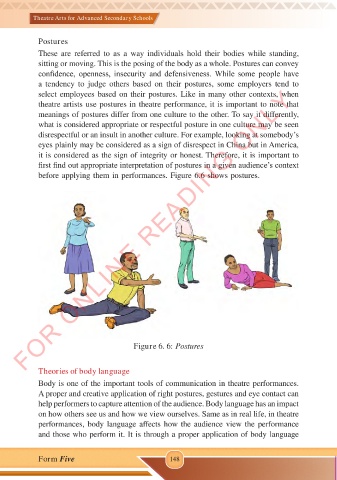
            These  are  referred  to  as a way individuals  hold  their  bodies  while  standing,
            sitting or moving. This is the posing of the body as a whole. Postures can convey
            confidence,  openness,  insecurity  and  defensiveness.  While  some  people  have
            a tendency to judge others based on their postures, some employers tend to
        FOR ONLINE READING ONLY
            select employees based on their postures. Like in many other contexts, when
            theatre artists use postures in theatre performance, it is important to note that
            meanings of postures differ from one culture to the other. To say it differently,
            what is considered appropriate or respectful posture in one culture may be seen
            disrespectful or an insult in another culture. For example, looking at somebody’s
            eyes plainly may be considered as a sign of disrespect in China but in America,
            it is considered as the sign of integrity or honest. Therefore, it is important to
            first find out appropriate interpretation of postures in a given audience’s context
            before applying them in performances. Figure 6.6 shows postures.


                                         Figure 6. 6: Postures


            Theories of body language

            Body is one of the important tools of communication in theatre performances.
            A proper and creative application of right postures, gestures and eye contact can
            help performers to capture attention of the audience. Body language has an impact
            on how others see us and how we view ourselves. Same as in real life, in theatre
            performances, body language affects how the audience view the performance
            and those who perform it. It is through a proper application of body language


            Form Five                              148


                                                                                          28/06/2024   15:05
   THEATRE ART F5 fnl.indd   148
   THEATRE ART F5 fnl.indd   148                                                          28/06/2024   15:05

