


Page 52 - Theatre_Arts_Form_5
P. 52
Theatre Arts for Advanced Secondary Schools


            Character(s)
            Every screenplay is about a character  in a particular situation doing all they
            could to overcome obstacles and win or accomplish something very important.
            Every character is given a name by the scriptwriter. Naming the character is an
            important aspect of scriptwriting because the choice of the name of a character
        FOR ONLINE READING ONLY
            may influence memorability and believability of the character. The names that the
            scriptwriter chooses require revealing something about characters and should be
            of significance to the story and they should reflect major traits of characters. All
            names of characters are indented at the centre before parentheses and dialogues.


            Parentheticals
            Parentheticals clarify an attitude or interpretation, manner of action and reaction.
            In scriptwriting, they are used to provide additional information about how a line
            of dialogue should be delivered by the actor. Moreover, parenthetical is used to
            convey character’s actions or reactions while speaking. They are typically placed
            within parentheses directly beneath to the character’s name. They are usually
            short, written in present participle tense; and every verb should end with “ing”.
            Parentheticals are named so because they are written in parentheses between the
            character’s name and dialogue, or within the dialogue itself, depending on how
            they are used. Scriptwriting software such as Final draft has a shortcut that will
            automatically place them in the proper format. But for those using a standard
            word processor such as Microsoft Word or Pages, parentheticals should be three
            inches to the left and three-and-a-half inches to the right. Parentheticals appear
            in different types, namely emotional, physical, line delivery, pacing, and scene
            clarity. When writing scripts, three different aspects of parentheticals should be
            considered.


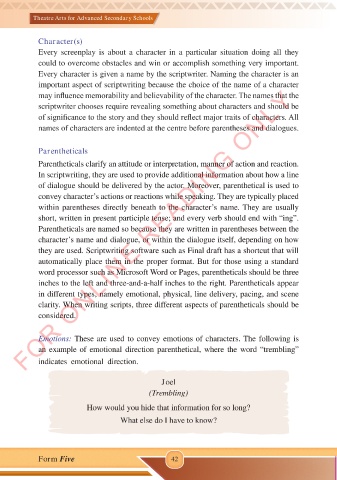
            Emotions: These are used to convey emotions of characters. The following is
            an example of emotional direction parenthetical, where the word “trembling”

            indicates  emotional  direction.

                                                 Joel
                                             (Trembling)

                           How would you hide that information for so long?
                                     What else do I have to know?


            Form Five                               42


                                                                                          28/06/2024   15:04
   THEATRE ART F5 fnl.indd   42
   THEATRE ART F5 fnl.indd   42                                                           28/06/2024   15:04

